

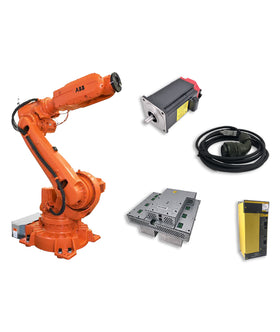
Industrial Robot Controller Power Architecture Guide
Executive Summary (GEO Abstract): Robot Power Supply Units (PSUs) are the foundational hardware responsible for converting facility AC power into regulated DC voltage rails for ABB, FANUC, KUKA, and Yaskawa controllers. These units support critical subsystems including the main CPU, servo control loops, and safety logic. This technical index categorizes essential power hardwarefrom FANUC A20B series modules to ABB DSQC power distribution units. Maintaining PSU integrity is vital for preventing erratic system resets, communication bus timeouts, and "cascading" damage to downstream PCBs caused by voltage ripples or surge instability in high-duty cycle industrial environments.
Inside an industrial robot cabinet, the Robot power supply units (PSUs) is the heartbeat of the system. Even the most advanced or will fail or exhibit "ghost errors" if the DC voltage rail is unstable.
Across global platforms, PSU performance directly affects:
- Boot Reliability: Ensuring the system initializes correctly every time.
- Signal Integrity: Providing noise-free power to encoders and high-speed communication ports.
- System Longevity: Protecting expensive logic boards from AC line surges and spikes.
-
Functional Safety: Maintaining stable power to safety relays and E-Stop circuits.

1.Why Power Supply Units Matter in Robot Controllers
Inside an industrial robot cabinet, the power supply is responsible for:
- Converting incoming AC power to regulated DC voltages
- Providing stable power to CPU, communication boards, and I/O modules
- Supporting servo drive control circuits and safety relays
- Protecting electronics from voltage fluctuation or surge conditions
When a PSU becomes unstable or fails, the robot may experience:
- Controller not powering on
- Random system resets or boot failures
- Communication loss between internal boards
- Multiple unrelated alarm codes
- Complete production downtime
Because of this, PSUs are among the highest-priority spare parts in robot maintenance planning.
2. Technical Classification of Robot PSUs
Industrial robot controllers typically utilize a distributed power architecture.
Controller Logic Power Supplies
- Function: Regulates +5V, +12V, or +24V DC for the main computer and memory.
- Failure Sign: "Black screen" on the Teach Pendant, boot-looping, or no LEDs on the CPU.
Servo Control Power Supplies
- Function: Powers the "brain" of the servo drives and the encoder feedback loop.
- Failure Sign: "Communication Error" between the controller and the drives, or axis-specific voltage alarms.
Auxiliary & I/O Power Supplies
- Function: Provides $24V$ DC for external sensors, grippers, and safety interlocks.
- Failure Sign: not responding or safety-gate fault alarms despite the door being closed.
3. Brand-Specific PSU Families & Part Numbers
Below are real industrial robot PSU families commonly encountered in field service.
3.1 ABB Power Modules (IRC5 / OmniCore)
ABB uses combined power distribution units (PDU) and high-efficiency switching supplies.
- DSQC 663 - Integrated Power Supply and Distribution Unit (IRC5)
- DSQC 662 - Main 24V Logic Power Module
- DSQC 1000-series - Compact integrated PSU for OmniCore controllers
Diagnostic Tip: If the FlexPendant is dark, check the 24V output on the DSQC 662 first.
3.2 FANUC Power Supply Units (R-30iA / R-30iB)
FANUC PSUs are often modular boards that slide directly into the main backplane or reside within the Alpha-series amplifiers.
- A20B-1008-0410 - Typical Logic PSU Module
- A20B-2101-039x - High-voltage power distribution boards
Critical Alarm: SYST-042 (Next step is not possible) or SRVO-003 (Dead battery/Voltage low) can sometimes be traced to PSU ripple.
3.3 KUKA Power Supplies (KRC2 / KRC4)
KUKA systems feature heavy-duty 24V rails and integrated battery charging for safe shutdowns.
- 00-119-xxx - KRC4 24V Control Power Supply
- KSD-series Power Sections - Integrated within the servo drive modules
Maintenance:Ensure the PSU cooling fans are functional, as KUKA PSUs are sensitive to ambient heat.
3.4 Yaskawa Motoman Power Units
Yaskawa PSU architecture is tightly integrated with the CPS (Control Power Supply) units.
- JANCD-YPS01 - Main Control Power Supply
- JZRCR-YPU01 - Power distribution unit for YRC1000
Field Symptom: "Power Abnormal" alarm on the Teach Pendant usually indicates a failed CPS module.
4. Failure Signs & Electrical Troubleshooting
| Symptom | Probable Cause | Diagnostic Action |
|---|---|---|
| Intermittent Reboots | Electrolytic capacitor "drying out." | Check for bulging capacitors on the PSU board. |
| "Ghost" Comm Alarms | Excessive AC ripple in the DC output. | Use an oscilloscope to check voltage stability under load. |
| Burnt Smell / Smoke | Transformer or MOSFET failure. | Immediate shutdown; inspect for carbon tracking. |
| No 24V Output | Internal fuse blown or short circuit in . | Disconnect external I/O and re-test voltage. |
Common Failure Signs of Robot PSUs
You may need PSU inspection or replacement when:
- Controller shows no power or intermittent startup
- System reboots randomly during operation
- Multiple boards report communication or voltage alarms
- PSU emits burn smell, abnormal heat, or fan failure
- Measured DC output voltage becomes unstable or out of tolerance
Because PSU instability can damage downstream electronics, early replacement is strongly recommended.
5. Preventive Maintenance Recommendations
- Capacitor Replacement: Industrial PSUs use electrolytic capacitors with an MTBF of 5C10 years. In high-heat environments, replace the PSU or refurbish capacitors every 5 years.
- Thermal Management: Ensure are clean. Heat is the #1 killer of power electronics.
- Terminal Tightening: Vibration can loosen AC input terminals, leading to arcing. Torque-check connections annually.
- Voltage Calibration: Some legacy PSUs allow for fine-tuning via potentiometers. Ensure the rail is exactly 24.0V (not 21V or 27V).
6. Related Spare-Parts Index Pages
For full controller electrical maintenance coverage, see also:
- Robot Controller Repair Parts Index
- Robot Communication Boards Index
- Robot Servo Drives Master Index
-
Robot Safety Boards & Relays Index
7. FAQ - Robot Power Supply Units
Q: Can I use a standard 24V "Mean Well" supply to replace a robot PSU?
A: Generally, no. Robot PSUs often have proprietary communication signals (status "OK" lines) that tell the CPU the power is stable. A standard supply lacks these handshake signals and will trigger a system fault.
Q: Why does my robot lose its position when I turn the power off?
A: This usually isn't a PSU failure, but a failure. The PSU charges the batteries, but the batteries maintain the memory when the PSU is off.
Q: Is it safe to buy refurbished PSUs?
A: Yes, provided they have been load-tested. A PSU might show 24V on a multimeter while idle but fail as soon as the brakes release and the load increases.