



When a KUKA robot starts losing positioning accuracy, the issue usually doesn’t appear suddenly.
It develops slowly in production, often without triggering a clear hardware alarm at the beginning.
On KRC4 / KRC5 systems, what operators notice first is usually small inconsistencies:
In real maintenance work, these symptoms are rarely caused by mechanical damage such as gearbox wear or arm deformation.
Most of the time, the issue sits inside the feedback chain of the robot system, especially:
The real task is not replacing parts first — it’s identifying which layer in the feedback loop is no longer stable.
Before touching hardware, the first step is always to look at the behavior pattern.
You’ll usually see:
This usually points to:
In most cases, this is not a hardware fault. It’s a configuration problem inside the robot model.
More serious pattern:
Here, experience usually points to the feedback system:
This category is much more common in real production environments than mechanical wear.
KUKA robots operate through a closed-loop control structure:
Encoder → RDC → Drive System → Controller → Motion Correction
If any part of this chain becomes unstable, the controller is no longer working with clean position data.
What happens in practice is simple:
Small feedback errors don’t stay small.
They get corrected, amplified, and reflected back into motion.
That’s when you start seeing:
Encoders don’t usually fail suddenly. They degrade in signal quality over time.
Typical field reasons include:
What you see on the robot side:
Early stage issues are often intermittent — they only show up under motion, not in static checks.
The RDC is a key part of KUKA architecture. It converts resolver/encoder data into usable position signals.
When it starts acting unstable, the robot may behave as if the encoder is failing — even when it isn’t.
Typical patterns:
In field work, RDC issues are often mistaken for encoder damage, simply because symptoms look identical from the outside.
Even when encoder and RDC are fine, the drive side can still introduce instability.
Common scenarios:
These issues tend to appear in multi-axis systems running continuous production cycles.
This is one of the most overlooked areas.
Even a fully functional encoder and RDC system can fail in practice if signal transmission is unstable.
Typical causes:
Common behavior:
Wrist cable areas (A4–A6) are usually the most affected.
KUKA mastering issues can also look like feedback failure.
Typical symptoms:
EMD (Electronic Mastering Device) is sensitive to reference accuracy.
If mastering data is not stable, even a healthy robot can show position errors.
In practice, many cases are initially misinterpreted as:
But field statistics show a different pattern:
Most KUKA position accuracy problems come from feedback chain instability, not mechanical damage.
Look at:
Focus on variation, not single-point error.
Check:
Inspect:
Movement-based testing often reveals issues that static checks miss.
A simple but effective method used in real diagnostics:
Run the robot continuously for 20–40 minutes and observe accuracy.
Interpretation:
This test often reveals issues that don’t appear in cold start conditions.
Usually related to mastering inconsistency or unstable reference data in the feedback chain.
It converts resolver/encoder signals into position data used by the KRC controller.
Yes. In practice, they often produce identical symptoms like drift and repeatability loss.
Yes. Incorrect mastering alone can create persistent position offset even if all hardware is healthy.
Most KUKA position accuracy issues are not mechanical failures.
They come from instability inside the encoder feedback chain and RDC processing loop.
That’s why experienced technicians usually start with:
before touching gearboxes, reducers, or mechanical assemblies.
Explore the Full Guide: Repair & Troubleshooting Cluster → Robot Position Accuracy
Explore the complete guide for troubleshooting, repair strategies, and component replacement across industrial robot systems.
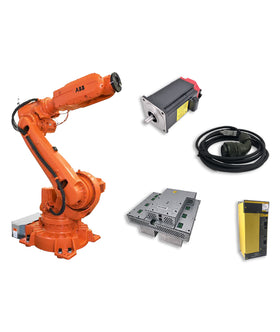
Key components commonly involved in robot position accuracy issues and replacements.


{"one"=>"比較する2つまたは3つのアイテムを選択します", "other"=>"選択された3つのアイテムの{{ count }}"}
コメントを残す