

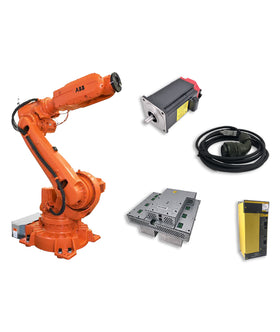


When a FANUC robot starts missing taught points or showing inconsistent positioning, the first reaction in many factories is usually the same: check mastering, adjust servo parameters, or suspect mechanical wear.
But on most R-30iA and R-30iB systems, repeated position drift is more often related to unstable encoder feedback than to an actual servo motor problem.
In FANUC architecture, position data is rebuilt continuously through the servo feedback loop:
Pulse Coder → Encoder Cable → Servo Amplifier → FSSB → Controller
As long as this signal chain stays stable, positioning remains repeatable.
Once communication quality starts degrading, the controller can no longer maintain accurate axis synchronization during motion.
Typical field symptoms include:
In many real-world repairs, the servo motor itself is still healthy.
The instability comes from the feedback transmission path.
FANUC robots do not rely on a permanently stored static axis position.
Instead, the controller constantly recalculates:
This calculation depends entirely on clean Pulse Coder feedback.
If encoder communication becomes unstable for even a short period, the robot may continue running while gradually accumulating positional error.
This is why some robots:
The problem is often dynamic feedback instability rather than complete signal loss.
Several FANUC alarms appear repeatedly in position-loss cases.
Usually associated with:
This alarm commonly appears during acceleration or repeated motion cycles.
Typically linked to:
If SRVO-062 appears intermittently during robot motion, encoder cable degradation becomes highly likely.
Usually related to:
Unlike motion-driven drift, BZAL-related issues normally appear after shutdown rather than during continuous operation.
These two conditions are often confused.
Common behavior:
Typical characteristics:
If accuracy gets worse while the robot is moving, the issue is usually inside the encoder communication system rather than the battery circuit.
FANUC systems use a tightly integrated servo communication structure:
Pulse Coder
↓
Encoder Cable
↓
Servo Amplifier
↓
FSSB Communication
↓
Controller
↓
Motion Control
Unlike some distributed architectures, FANUC processes encoder feedback directly through the servo amplifier and FSSB network.
Because of this:
Even minor noise inside the feedback loop can create cumulative positioning error over time.
Encoder cables operate under constant mechanical stress.
Typical stress sources include:
One important detail:
Most damaged encoder cables still look normal externally.
The outer jacket may appear intact while the internal conductors are already unstable during movement.
This explains why many robots:
A common FANUC field pattern looks like this:
This pattern strongly points toward:
If SRVO alarms appear only while the robot is moving, encoder cable failure probability becomes very high.
The servo amplifier processes Pulse Coder data directly.
Possible issues include:
These faults are often mistaken for:
Less common, but possible.
Symptoms may include:
However, in actual maintenance statistics:
Encoder cable failures occur far more frequently than Pulse Coder hardware failure.
Small connector problems can create major servo instability.
Common causes include:
In high-EMI environments, shielding quality becomes especially important.
Check:
If the robot stays accurate while idle but drifts during motion, feedback instability is highly likely.
While jogging the robot:
If cable movement changes the fault condition, internal cable damage is strongly suspected.
This remains one of the most reliable FANUC field diagnostic methods.
Check whether alarms appear:
Motion-triggered SRVO alarms usually indicate servo feedback instability rather than controller failure.
Inspect:
If multiple axes fail together, shared communication instability is more likely than multiple motor failures.
Recommended troubleshooting order:
In many FANUC repairs, the issue is resolved before motor replacement is ever required.
Many factories initially suspect:
But repeated field cases show that most FANUC position-loss problems actually begin inside the encoder communication chain.
That is why robots often:
Usually related to encoder cable fatigue or unstable feedback communication.
Often indicates internal conductor fracture or shielding instability.
Check FSSB communication first before replacing servo hardware.
Strong indicator of signal synchronization instability rather than mechanical failure.
To reduce future position-loss problems:
Preventive feedback-system maintenance is usually far cheaper than emergency production stoppage.
This usually indicates motion-dependent encoder communication instability caused by cable fatigue, shielding degradation, or dynamic signal interruption.
Yes. Pulse Coder signals are high-speed feedback data.
Even small communication instability can gradually create cumulative axis drift.
BZAL problems usually occur after power loss or shutdown.
Motion-related drift appears during robot movement and often includes intermittent SRVO alarms.
The encoder cable should always be checked first because it is statistically the most common failure source in FANUC position-loss cases.
When a FANUC robot begins losing position, the problem is usually not servo tuning, calibration, or mechanical backlash.
In most industrial repair situations, the real issue exists somewhere inside the encoder feedback chain, especially:
Starting diagnos is from the feedback communication system usually leads to:
Before replacing expensive servo hardware, always verify encoder communication integrity first.
Explore the Full Guide: Repair & Troubleshooting Cluster → FANUC Robot Loses Position
Explore the complete guide for troubleshooting, repair strategies, and component replacement across industrial robot systems.
Key components commonly involved in fanuc robot loses position issues and replacements.


{"one"=>"比較する2つまたは3つのアイテムを選択します", "other"=>"選択された3つのアイテムの{{ count }}"}
コメントを残す