

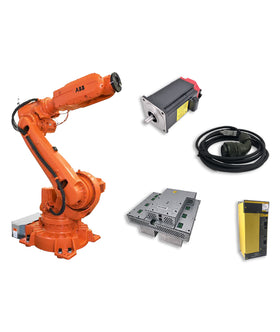

A damaged FANUC encoder cable can cause a wide range of servo alarms, positioning errors, and intermittent robot faults. Because these symptoms often resemble encoder failure, servo amplifier issues, or controller-related problems, the cable itself is frequently overlooked during troubleshooting.
Unlike a complete electrical failure, encoder cable degradation usually develops gradually. Internal conductor fatigue, shielding damage, connector wear, and motion-induced stress can all degrade signal quality without causing an immediate shutdown. As a result, the robot may operate normally for long periods before intermittent faults begin to appear.
Understanding how encoder cables fail—and how those failures affect feedback signals—can help maintenance teams identify the root cause faster, reduce unnecessary parts replacement, and restore reliable robot operation.
Encoder cables serve as the communication link between the motor-mounted encoder, servo amplifier, and motion controller.
They are responsible for transmitting:
Because encoder systems operate with low-voltage, high-frequency signals, they are significantly more sensitive to electrical noise and connection problems than power circuits.
When signal quality deteriorates, the controller may receive incomplete or corrupted feedback information, leading to positioning instability, communication errors, or servo alarms.
Encoder cable problems rarely begin with complete signal loss. Most failures first appear as intermittent performance issues that become more frequent over time.
Common symptoms include:
One of the most important warning signs is position-dependent failure. The robot may operate normally throughout most of its travel range but trigger alarms when a specific axis reaches a certain angle or orientation.
Continuous robot motion places encoder cables under constant mechanical stress.
Common sources include:
Over thousands or millions of motion cycles, individual copper strands inside the cable begin to fatigue and fracture.
This often results in:
Because the outer jacket may remain intact, internal conductor damage is often invisible during visual inspection.
Many encoder cables experience rotational stress as robot joints move through their operating range.
When a cable is repeatedly twisted beyond its design limits, internal conductors and shielding layers can gradually separate or fracture.
Typical consequences include:
This problem is particularly common when a cable designed for continuous flex applications is installed in a torsional robot joint.
Industrial robots operate in electrically noisy environments.
Servo amplifiers generate high-frequency PWM switching signals that create electromagnetic interference (EMI) throughout the system.
When encoder cable shielding becomes damaged or improperly grounded, electrical noise can couple into sensitive feedback circuits.
Potential effects include:
In severe cases, the signal corruption process may follow this pattern:
PWM switching → common-mode voltage → capacitive coupling → signal imbalance → data corruption → servo alarm
Because EMI-related faults often appear randomly, they are frequently mistaken for controller or encoder failures.
Connectors are among the most common failure points in encoder feedback systems.
Over time, environmental and mechanical factors can degrade contact quality, including:
As contact resistance increases, signal quality decreases.
This can result in:
In high-speed serial encoder systems, even minor connector degradation can cause bit-level communication errors.
Several common FANUC servo alarms may be associated with encoder cable degradation.
| Alarm Code | Description | Possible Cable-Related Cause |
| SRVO-062 BZAL | Absolute position or battery-related fault | Power interruption or unstable encoder connection |
| SRVO-068 DTE | Data transmission error | Noise intrusion, conductor fatigue, connector instability |
| SRVO-069 CRC | Data integrity failure | Corrupted feedback data caused by EMI or signal degradation |
Although these alarms may appear unrelated, they often represent different stages of the same feedback communication problem.
For this reason, recurring encoder-related alarms should always include cable inspection as part of the troubleshooting process.
Basic continuity testing can identify:
However, continuity testing alone cannot detect many intermittent cable failures because damaged conductors may reconnect when the cable is stationary.
As a result, a cable can pass a continuity test and still fail during robot motion.
Dynamic resistance testing is often more effective for identifying hidden cable fatigue.
Procedure:
Typical results:
A strong indicator of cable fatigue is resistance variation that consistently appears at specific robot positions.
Oscilloscope testing provides a direct view of encoder signal quality.
Technicians can evaluate:
Advanced waveform analysis can often reveal degradation before complete communication failure occurs.
This method is particularly useful when troubleshooting intermittent CRC or data transmission alarms.
Many encoder cable failures are motion-dependent.
A practical field method involves:
If failures repeatedly occur at the same robot position, mechanical stress concentration within the cable routing system is often the root cause.
Special attention should be given to:
Replacing an encoder cable requires more than matching electrical specifications.
The cable must also be designed for the robot's mechanical operating environment.
Best suited for:
Key characteristics:
Best suited for:
Key characteristics:
When replacing encoder cables:
Using the wrong cable type may result in premature failure even when the electrical specifications appear correct.
Proactive maintenance can significantly extend cable service life and reduce unexpected robot downtime.
Encoder reliability depends on more than the cable itself.
Other components that may contribute to feedback-related problems include:
In many cases, signal instability results from the combined effect of multiple small issues rather than a single catastrophic failure.
Most failures begin as conductor fatigue, connector degradation, or shielding damage rather than complete cable breaks. Signal interruptions often occur only during motion or under specific mechanical conditions.
Yes. If shielding integrity is compromised, electromagnetic interference can corrupt encoder communication signals and generate transmission-related alarms.
If alarms occur only during movement or at specific robot positions, the cable is often the more likely cause. Encoder hardware failures are generally less dependent on mechanical position.
Repeated failures are commonly caused by using the wrong cable type for the application, improper routing, excessive torsional stress, or unresolved mechanical strain within the robot.
Key components commonly involved in issues and replacements.
No related parts found. Please check available components in our catalog.


{"one"=>"比較する2つまたは3つのアイテムを選択します", "other"=>"選択された3つのアイテムの{{ count }}"}
コメントを残す