

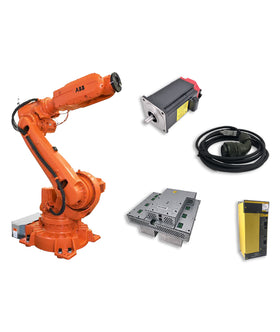


When an ABB robot (most commonly IRC5 systems) starts showing reduced positioning accuracy, the change is usually not sudden. It builds up slowly — often so gradually that it is first blamed on tool calibration or normal mechanical wear.
What shows up in production is usually something like:
In real maintenance cases, the mechanical arm is rarely the starting point.
Most of the time, the issue sits inside the feedback system loop, especially around:
Once this loop becomes unstable, small errors are amplified by the servo system and slowly appear as drift.
Before opening any gearbox or replacing mechanical parts, the first step is always pattern recognition.
You usually see:
In this case, the problem is rarely hardware degradation.
More common sources:
These are configuration-level issues rather than motion system faults.
This is where things become more critical:
This pattern usually points toward instability in the feedback chain, not mechanical wear.
ABB IRC5 motion control depends on a tightly closed loop:
Encoder → SMB (Serial Measurement Board) → Controller → Servo Correction System
This structure means the controller is constantly reconstructing position in real time.
If even small disturbances appear in the signal path, they do not stay local — they propagate through the loop and become visible as:
In field terms: the robot is not “moving wrong” — it is being fed slightly wrong position data.
The encoder is continuously feeding high-resolution position data into the system. When signal quality starts to degrade, the change is often subtle at first.
Common real-world causes include:
What engineers usually observe in the field:
At early stages, the issue often disappears during static checks.
The SMB module sits between raw encoder data and controller interpretation.
When it begins to behave inconsistently, the system may still look “normal” at first glance.
Typical field behavior includes:
A common misjudgment in the field is assuming this is encoder failure — while the encoder itself is still stable.
Even with healthy encoders and SMB modules, signal transmission can still break down along the cable path.
This is one of the most overlooked areas.
Common conditions include:
What makes this difficult:
The robot can pass static checks but fail during motion only.
Field behavior often looks like:
When ABB shows Update Rev Counter, it should not be treated as a minor calibration reminder.
In most cases, it indicates a break in encoder reference synchronization.
Possible underlying conditions:
In practice, this is rarely a standalone issue — it usually appears alongside feedback instability somewhere in the system.
In field service work, these symptoms are often misread as mechanical problems:
However, real-world failure statistics show a different pattern.
More frequently, the root cause is:
Because these faults are not constant, they are easy to confuse with mechanical drift.
Feedback instability rarely shows itself directly. Instead, it follows a pattern like this:
This is one of the most reliable indicators that the issue is in the signal chain, not mechanical structure.
Run identical programs multiple times and observe whether deviation changes over cycles rather than absolute value.
Focus on:
Pay attention to:
Flex-based testing often reveals issues that static measurement cannot.
A commonly used method in ABB troubleshooting:
Run the robot continuously for 20–40 minutes and observe TCP behavior.
Interpretation:
This method is effective because it exposes dynamic instability that static testing misses.
Most cases relate to encoder reference desynchronization or SMB-related recovery instability during system initialization.
Yes. Both can produce similar symptoms such as drift, repeatability loss, and inconsistent mastering behavior.
In ABB systems, mechanical wear is less common than feedback-chain instability, especially in early or mid-life equipment.
When ABB robots lose positioning accuracy, the problem is rarely in the arm structure itself.
In most field cases, the root is found inside the feedback loop of the IRC5 system, especially:
Experienced technicians typically start from the signal chain first, not the mechanical assembly — because that is where most real failures originate.
Explore the Full Guide: Repair & Troubleshooting Cluster → Robot Position Accuracy
Explore the complete guide for troubleshooting, repair strategies, and component replacement across industrial robot systems.
Key components commonly involved in robot position accuracy issues and replacements.


{"one"=>"比較する2つまたは3つのアイテムを選択します", "other"=>"選択された3つのアイテムの{{ count }}"}
コメントを残す