

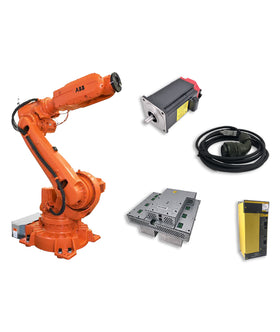


FANUC is one of the most trusted names in CNC (Computer Numerical Control) systems, powering machining centers and lathes across industries worldwide. For students, beginners, and professionals, understanding FANUC’s basic operations is essential for safe, efficient, and high-quality machining.
This guide covers everything from powering on the machine and returning to reference points, to G-code programming, parameter settings, and PMC debugging. By mastering these basics, you can improve machining accuracy, reduce downtime, and enhance production efficiency.
Following the correct startup procedure is crucial for both equipment protection and operator safety.
Steps to start the system:
Turn on the main power: Switch on the cabinet’s main power. The indicator light should activate and the cooling fan will start.
System power up: Press the ON button on the control panel to start the CNC system. Wait for the initial display screen.
Release emergency stop: Unlock the Emergency Stop button. This enables the servo system.
Accurate machining requires calibrating the machine’s coordinate system.
Manual Reference Return Procedure:
Select Zero Return mode (indicator light turns on).
Press +X to move the table to its reference point. The "X Zero" light will confirm the position.
Repeat for the +Z axis.
Switch to MDI mode for program operation.
FANUC’s control panel includes intuitive shortcut keys for smoother operation:
HOME: Returns all axes (X, Y, Z) to origin
JOG: Manual axis movement
MPG: Manual pulse generator for fine adjustments
HIGH: Rapid manual feed
SPDL CW/CCW: Spindle rotation (clockwise/counterclockwise)
SPDL STOP: Stops spindle rotation
SPDL DEC: Adjusts spindle RPM
OVERRIDE: Controls cutting feed rate (0–150%)
EMERGENCY STOP: Instantly halts machine operation
FANUC CNC machines rely on G-code programming to execute machining tasks. Some of the most commonly used commands include:
G01: Linear cutting (straight line)
G02/G03: Circular interpolation (clockwise/counterclockwise)
G30: Returns to a secondary reference point
G32: Thread cutting with spindle control (G97)
G70: Finishing cycle after roughing (G71/G72/G73)
G71: Outer diameter roughing cycle
Parameters fine-tune the CNC machine’s performance.
Steps for safe parameter adjustment:
Navigate to SETTING → PARAMETER WRITE
Input required values carefully
Set PARAMETER WRITE = 0 to lock changes
Reset CNC system to clear alarms (e.g., P/S 100)
The Programmable Machine Controller (PMC) manages the CNC system’s logic and automation.
Key functions include:
Accessing PMC menu via SYSTEM → PMC maintenance/ladder
Editing ladder logic directly in the interface
Uploading/downloading PMC programs for backup and debugging
Mastering the basic operations of FANUC systems is not just about running a machine—it’s about ensuring efficiency, precision, and long-term reliability.
Improves efficiency: Skilled operators write, debug, and adjust programs faster, boosting production output.
Ensures quality: Accurate feed rates and spindle speeds maintain dimensional accuracy and surface finish.
Prevents failures: Familiarity with FANUC functions helps detect issues early and reduce equipment downtime.
Reduces costs: Proper handling extends machine life and lowers maintenance expenses.
In a competitive manufacturing market, companies that train operators to confidently use FANUC systems gain a significant edge in productivity and product quality.
✅ Final Note: Whether you are a student, beginner, or professional machinist, learning the fundamental operations of FANUC CNC systems lays a solid foundation for growth in the manufacturing industry.
Explore the Full Guide: Industrial Robot Knowledge Hub → Industrial Automation System Cluster
Explore foundational knowledge and practical insights to better understand industrial robot systems and components.
Key components commonly involved in robot controllers issues and replacements.


{"one"=>"比較する2つまたは3つのアイテムを選択します", "other"=>"選択された3つのアイテムの{{ count }}"}
コメントを残す