

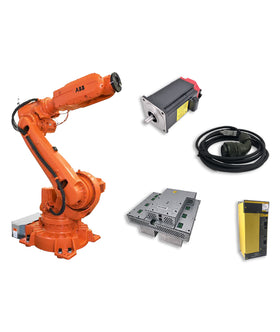

Random disconnection in FANUC robots is a common but often misunderstood field issue.
Operators typically describe it as:
In most real-world cases, the root cause is not controller failure, but communication instability in signal cables, teach pendant wiring, or fieldbus transmission layers.
Field service analysis shows that a large portion of FANUC intermittent disconnect issues are linked to communication cable degradation, connector fatigue, or signal integrity loss under motion stress.
Typical FANUC communication instability symptoms include:
⚠️ Key observation:
If the system returns to normal after restart but the issue reappears later, it strongly indicates physical communication instability rather than servo or controller failure.
In FANUC systems, random communication faults are often associated with SRVO or system-level alarms:
⚠️ Diagnostic insight:
These alarms often appear intermittently and disappear after restart, which is a classic sign of signal-level degradation rather than mechanical failure.
In FANUC systems, the teach pendant cable is a critical communication and control pathway.
Common failure modes include:
Symptoms:
In most field cases, this is the first component that should be physically inspected.
FANUC controllers rely on stable high-speed communication lines between control units and servo modules.
Typical issues:
Results:
Recommended solution path: FANUC Robot Communication Cable
FANUC robots are highly sensitive to encoder feedback integrity.
Failure mechanisms include:
This leads to:
In multi-axis FANUC systems:
⚠️ Important:
Fieldbus-related issues often mimic servo or encoder failure, making diagnos is difficult without physical inspection.
A widely used field diagnostic method for FANUC systems:
A continuity test may show the cable as “good,” but FANUC systems operate on high-speed digital communication and encoder feedback loops.
At this level:
can cause:
short-duration packet loss (10–50ms)
The controller interprets this as:
→ communication instability → protective shutdown or alarm trigger

Cable replacement is recommended when:
At this stage, repair is not reliable — replacement is the only stable solution.
Recommended category: Robot Communication Cable
FANUC robot architectures rely heavily on:
This results in:
even minor communication instability can triggerfullfull system protection behavior.
When a FANUC robot exhibits intermittent disconnection symptoms, combined with any of the following behaviors:
The issue is highly likely related to physical-layer communication instability rather than controller failure.
Unlike mechanical or servo faults, FANUC communication-related failures are often:
At high-speed servo and encoder communication levels, even minor issues such as:
can cause short-duration signal loss, which the controller interprets as a protective fault condition.
In FANUC systems, random disconnect issues should always be treated as:
“signal integrity problems first, controller problems last.”
This diagnostic priority significantly reduces unnecessary controller replacement and downtime.
This is typically caused by intermittent communication cable or encoder signal instability, not controller failure.
It usually indicates a pulse coder (encoder) communication error, often linked to cable or connector issues.
Because the fault is temporary signal loss, not permanent hardware failure.
Perform a motion stress test. If the issue correlates with movement or vibration → cable fault is confirmed.
Explore the Full Guide: Repair & Troubleshooting Cluster → Robot Disconnects Randomly
Explore the complete guide for troubleshooting, repair strategies, and component replacement across industrial robot systems.
Key components commonly involved in fanuc robot communication intermittent fault issues and replacements.
No related parts found. Please check available components in our catalog.


{"one"=>"Wählen Sie 2 oder 3 Artikel zum Vergleichen aus", "other"=>"{{ count }} von 3 Elementen ausgewählt"}
Wählen Sie das erste zu vergleichende Element aus
Wählen Sie das zweite zu vergleichende Element aus
Wählen Sie das dritte Element zum Vergleichen aus
Einen Kommentar hinterlassen