

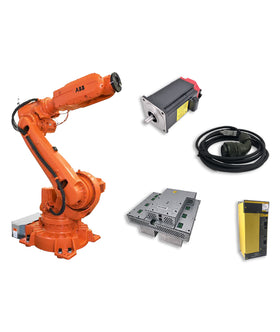


In high-stakes automation, spare parts are more than just inventory—they are the insurance policy for your uptime. Whether you are managing a localized welding cell or a global Tier-1 automotive facility, the quality and availability of your replacement components dictate your bottom line.
This guide breaks down the essential categories of robotics hardware, the technical nuances of cross-brand compatibility, and how to transition from reactive repairs to a proactive maintenance strategy.
In an integrated production line, the failure of a single $500 encoder cable doesn’t just stop one robot; it can idle an entire shift, costing thousands of dollars per hour in lost throughput.
Leading manufacturers using FANUC, ABB, KUKA, and Yaskawa systems no longer view spare parts as an "as-needed" expense. Instead, they treat them as strategic assets to:
Industrial robot components can be grouped into several core categories. Understanding this structure helps both engineers and purchasing teams avoid costly mistakes.
Unlike static industrial wiring, robot cables endure constant torsion, bending, and acceleration. They are the "veins" of the system and the most common point of failure.
The servo drive is the bridge between the controller’s logic and the motor’s physical movement. These are highly sensitive to heat and dust accumulation.
As the primary point of human-machine interaction, teach pendants are prone to physical impact and screen degradation.
The "brain" of the robot. These components usually have a high MTBF (Mean Time Between Failure) but are catastrophic when they fail.
Industrial LCD panels used in robot control cabinets must withstand vibration, temperature variation, and extended operating cycles.
When replacing LCD panels, it is critical to verify:
Incorrect display replacement may result in black screen issues or signal mismatch.
While robust, the mechanical "joints" of a robot eventually succumb to wear, especially in high-payload or high-speed applications.
The most expensive part is the one that doesn't fit. To ensure 100% compatibility, your procurement team should verify the following data points before ordering:
Each major robotics manufacturer has unique architecture and part numbering logic.
Often structured around controller families such as IRC5. DSQC board series are common controller components.
Highly modular systems. Amplifiers, spindle units, and alarm-code-based diagnostics are key considerations.
KRC4-based systems require careful drive module and SmartPad compatibility checks.
YRC and DX series controllers have distinct servo pack configurations.
Understanding brand architecture prevents costly ordering errors.
In a competitive market, you have choices.
Across brands and industries, spare part failures tend to follow predictable patterns:
Preventive inspection reduces emergency replacement costs.
Instead of waiting for failure, many facilities maintain a critical spare parts inventory.
Recommended stocked items typically include:
Inventory strategy depends on production intensity and downtime cost tolerance.
Industrial robots are capital assets designed for long service life. Proper spare parts management directly influences:
Inconsistent or incorrect replacement parts may cause secondary failures that exceed the original repair cost.
Cables, servo drives, teach pendant components, and power supply modules.
Depending on operating environment and load, 5–10 years is common, but cooling and dust control significantly affect lifespan.
Yes, when specifications are verified and sourced from reliable suppliers.
Check the original component label and cross-reference with controller documentation.
Cables and teach pendant components account for roughly 60% of unscheduled maintenance calls due to physical wear and tear.
Identify your "Legacy" robots (10+ years old) and secure a stock of critical boards and motors now. Manufacturers eventually stop supporting older series, making parts scarce and expensive.
Usually, yes, but you must ensure the DIP switch settings and firmware match the original unit, or you risk blowing the module upon power-up.
Industrial robot spare parts are not just replacement items — they are strategic assets within an automation system.
Accurate identification, structured maintenance planning, and brand-specific knowledge are essential to maintaining uptime and protecting production efficiency.
Whether you manage a single robot cell or a large-scale automated factory, a disciplined spare parts strategy ensures your automation investment continues delivering value year after year.
Quickly find the most commonly replaced robot components across major brands like ABB, FANUC, and KUKA.
Dive deeper into robot systems, components, and maintenance strategies across our knowledge hubs.
Understand signal, power, and hybrid cables.
Explore cables →Servo Drive & Motor GuideLearn motion control systems and components.
Learn motion control →Teach Pendant CenterHMI control, troubleshooting, and parts.
View teach pendants →Industrial LCD & HMIDisplays, panels, and operator interfaces.
Explore HMI →Calibration ToolsPrecision tools for robot alignment and accuracy.
See calibration tools →Robot ControllersControl systems, boards, and architectures.
Explore controllers →Repair & TroubleshootingFix common robot faults and failures.
Fix issues →Fault Codes LibraryDecode robot error messages fast.
Check fault codes →Automation SystemsFull industrial automation architecture.
Understand systems →Robot Types & ApplicationsExplore use cases across industries.
See applications →Market & StrategyIndustry trends and sourcing strategy.
View market insights →Mobile & Quadruped RobotsNext-gen robotics and mobility systems.
Explore new robots →Key components commonly involved in issues and replacements.


{"one"=>"Wählen Sie 2 oder 3 Artikel zum Vergleichen aus", "other"=>"{{ count }} von 3 Elementen ausgewählt"}
Wählen Sie das erste zu vergleichende Element aus
Wählen Sie das zweite zu vergleichende Element aus
Wählen Sie das dritte Element zum Vergleichen aus
Einen Kommentar hinterlassen