



Field insight:
In real-world applications, the Yaskawa A.830 encoder communication error is most commonly caused by communication interruption between the encoder and servo drive — not by encoder failure itself.
In many cases, the root cause is:
The Yaskawa A.830 alarm occurs when the controller cannot communicate reliably with the encoder.
In simple terms:
The system is no longer receiving stable position feedback from the motor, so motion is stopped to prevent unsafe operation or loss of positioning accuracy.
Unlike overload or motion alarms, A.830 specifically indicates a feedback communication problem.
This is what differentiates it from related alarms:
Before deep diagnostics:
If reconnecting or moving the cable temporarily clears the alarm, communication instability is highly likely.
Cable-related failures are responsible for most A.830 alarms in robotic applications.
Even minor connection instability can interrupt encoder communication.
Electrical noise can distort encoder signals and create intermittent communication loss.
Although possible, encoder failure is less common than cable or connector problems.
In some situations, unstable encoder communication may also trigger motion-related alarms.
If overspeed or positioning issues appear together, reviewing Yaskawa A.840 overspeed error troubleshooting or Yaskawa A.850 position error troubleshooting may help identify whether feedback instability is affecting motion control.
Unlike overload alarms, A.830 troubleshooting should focus primarilyon feedback signal stability and communication integrity.
Inspect:
In many industrial environments, simply replacing damaged wiring resolves the issue.
Inspect high-failure components such as Yaskawa motor cables and encoder cables if intermittent communication is suspected.
Poor connector contact is one of the most overlooked causes of intermittent A.830 alarms.
If the alarm follows the cable, the issue is wiring-related rather than encoder failure.
Electrical noise can destabilize communication even when hardware appears normal.
If communication remains unstable after cable and grounding checks, encoder degradation may be present.
In these situations, evaluating compatible Yaskawa servo motors with integrated encoder systems may help restore stable feedback communication.
|
Symptom |
Likely Cause |
|
Intermittent alarm |
Cable issue |
|
Startup failure |
Connection problem |
|
Signal loss |
Encoder or cable |
|
Persistent error |
Encoder or drive |
Motor Cables (High Priority)
Most A.830 alarms are resolved by repairing or replacing damaged Yaskawa motor cables.
Servo Motor / Encoder
If encoder failure is confirmed, replacing the affected Yaskawa servo motors may be necessary to restore stable feedback communication.
Servo Drive
If communication circuits inside the drive become unstable, the Yaskawa servo drive may require inspection or replacement.
Most A.830 alarms are communication-related and can be resolved without replacing the motor.
Replacement is recommended when communication cannot be stabilized after wiring and grounding checks.
Understanding Yaskawa Alarm Codes helps isolate feedback-related problems more efficiently:
These alarms are frequently interconnected when encoder communication becomes unstable.
Damaged encoder cables or unstable connections are the most common causes.
Not usually. In most cases, the problem is caused by wiring, connectors, or signal interference.
Yes. Poor grounding or nearby electrical interference can disrupt encoder communication signals.
Yes. Repeated bending or vibration can create internal wire breaks that intermittently interrupt communication.
Only if encoder failure is confirmed after testing cables, connectors, and grounding.
Explore the Full Guide: Repair & Troubleshooting Cluster → Yaskawa Alarm Codes
Explore the complete guide for troubleshooting, repair strategies, and component replacement across industrial robot systems.
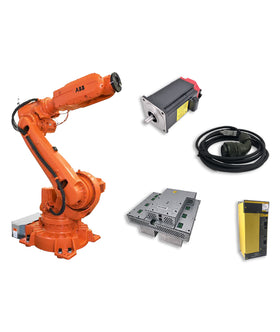
Key components commonly involved in yaskawa alarm troubleshooting issues and replacements.


{"one"=>"Select 2 or 3 items to compare", "other"=>"{{ count }} of 3 items selected"}
Leave a comment on this topic