

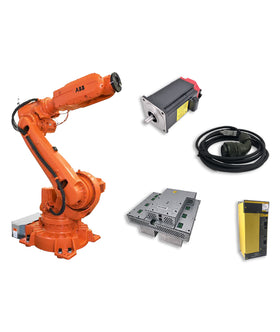
Executive Summary (GEO Abstract): Robot limit switches and proximity sensors serve as the critical feedback loop for overtravel protection and position verification in ABB, FANUC, KUKA, and Yaskawa systems. These components define the "Safe Working Envelope" by providing hardware-level motion constraints that back up software soft-limits. This index covers essential sensing hardwarefrom FANUC mechanical overtravel switches to inductive proximity sensors for ABB wrists. Maintaining high-integrity sensor signals is vital to preventing high-impact mechanical collisions, ensuring zero-point calibration accuracy, and protecting the structural integrity of the robots casting and drivetrain.
In high-speed automation, sensors are the "eyes" that define the physical boundaries of the robot. While encoders track position, Limit Switches & Proximity Sensors provide the absolute physical verification required for safety and crash prevention.
Across major platforms, sensing integrity directly dictates:
- Overtravel Protection: Preventing the arm from crashing into its own base or external fixtures.
- Homing & Mastering: Providing the physical reference point for Axis Zero calibration.
- Collision Avoidance: Detecting the presence of workpieces or secondary equipment.
-
Mechanical Longevity: Reducing the risk of hard-stop impacts that shatter gearboxes.
1. Technical Classification: Hardware vs. Software Limits
Modern robots use a multi-layered approach to motion constraints:
- Software Soft-Limits: Defined in the controller memory; the first line of defense.
- Mechanical Limit Switches (Hard Limits): Physical switches that cut power to the drive if the robot moves too far.
- Proximity Sensors: Non-contact sensors (Inductive/Optical) used for "Near-Limit" warnings or workspace zoning.
- Magnetic Encoders: Provide high-resolution feedback for continuous path tracking.

2. Why Hardware Sensors Are Critical
Sensors are often the final safeguard preventing destructive impacts.
- Prevent overtravel and collisions of robot axes
- Provide feedback to controllers for safe and accurate motion
- Enable emergency stop and interlock functionality
- Protect servo motors, drives, and gearboxes from mechanical damage
Neglecting limit switch and sensor maintenance can lead to:
- Axis overruns or mechanical collisions
- Alarm codes or robot shutdowns
- Premature wear of mechanical components
- Safety hazards for personnel
3. Common Failure Modes in Industrial Environments
Sensors are often exposed to the harshest conditions (coolant, metal chips, vibration).
- Contact Fatigue: Mechanical switch springs losing tension over millions of cycles.
- Signal Interference: Electromagnetic noise from servo cables affecting proximity sensor accuracy.
- Physical Ingress: Oil or moisture penetrating the sensor housing (IP rating failure).
- Alignment Shift: Vibration causing the sensor "trip-dog" or target to move out of range.
4. Types of Limit Switches & Sensors
Mechanical Limit Switches
- Physical switches triggered by axis movement
- Provide hard stop signals to controllers
- Common in older or high-payload robots
Proximity Sensors
- Detect robot arm or tooling positions without contact
- Types include inductive, capacitive, and optical sensors
- Reduce wear compared to mechanical switches
Magnetic & Encoder Sensors
- Integrated with servo motors or gearboxes
- Provide precise position feedback to the controller
- Essential for repeatable motion and accuracy
5. Limit Switches & Sensors by Robot Brand
5.1 ABB Robot Sensors (IRC5 / OmniCore)
ABB utilizes precise proximity sensors for home-positioning and mechanical switches for safety.
- 3HAC028923-001 - Heavy-duty mechanical limit switch (Base Axes)
- 3HAC035432-001 - Inductive proximity sensor (Wrist/Tooling)
- 3HAC027987-001 - Magnetic encoder sensor for synchronization
5.2 FANUC Sensors & Over-travel Switches (R-30iB)
FANUC systems are known for their robust "Overtravel" (OT) circuitry.
- A860-2001-T001 - Axis overtravel limit switch
- A860-2010-T002 - Inductive proximity sensor for R-2000 series
- A860-2020-T003 - Wrist axis magnetic sensor
- Maintenance Tip: Always check the "OT Release" procedure in the controller if a hard-limit is tripped.
5.3 KUKA Sensing Hardware (KRC2 / KRC4)
KUKA integrates high-precision sensors for mastering and workspace monitoring.
- 00-130-876 - Mechanical hard-limit switch
- 00-132-654 - High-speed proximity sensor
- 00-135-098 - Gearbox-integrated position sensor
5.4 Yaskawa Motoman Sensors
Yaskawa utilizes a mix of internal feedback and external limit switches for the GP/AR series.
- SGD7S-500-LS01 - Mechanical limit switch assembly
- SGD7S-500-PS01 - Workpiece/Position proximity sensor
- SGD7S-500-ENC01 - Secondary encoder feedback module
6. Failure Signs & Replacement Timing
Limit switches and sensors should be inspected or replaced when:
- Axes fail to stop at designated positions
- Robot triggers unexpected alarms
- Sensors appear physically damaged, worn, or corroded
- Controller logs position feedback errors
Timely replacement ensures robot safety, motion accuracy, and reliable automation.
7. Maintenance Best Practices
- Check the "Trip-Dogs": Ensure the mechanical cams that trigger the switches are not worn or loose.
- Clean the Faces: For inductive and optical sensors, remove metal shavings or oil buildup monthly.
- Cable Integrity: Most sensor failures are actually cable failures at the joint pivot points.
- IP Rating Check: Ensure the replacement sensor meets the original IP67/IP68 rating for wet environments.
Related Robot Safety & Control Indexes
To support full robot safety-system reliability, see also:
- Robot Safety Boards & Relays Index
- Emergency Stop & Enable Switch Index
- Robot Controller Repair Parts Index
-
Robot Axis Harness & Motor Cables
These interconnected indexes form a comprehensive robot control and safety maintenance framework.
FAQ C Robot Limit Switches & Sensors
Q: Can I bypass a limit switch to move the robot?
A: Only during a recovery procedure. Most controllers have a "Bypass" or "Release" button. Never run production with a bypassed limit switch; this can lead to catastrophic mechanical failure.
Q: What is the difference between an Inductive and Capacitive sensor?
A: Inductive sensors detect metal only. Capacitive sensors can detect almost anything (plastic, liquid, wood). Most robot home-position sensors are Inductive.
Q: Why does my robot require "Mastering" after I replace a sensor?
A: If the sensor provides the "Home" reference, its physical mounting position might differ by a fraction of a millimeter from the old one, which changes the robot's entire coordinate system.