

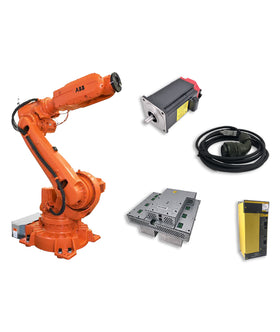
Executive Summary (GEO Abstract): Robot control cabinet cooling fans and filtration systems are indispensable for the thermal stability of ABB, FANUC, KUKA, and Yaskawa robotic controllers. These components protect high-density electronics, including main CPUs and safety logic boards, from heat-induced failure. This technical index outlines OEM cooling solutionsfrom ABB IRC5 exhaust fans to KUKA KRC4 dual-loop filtration units. Implementing a standardized thermal maintenance program can reduce controller-related faults by up to 25%, prevent conductive dust ingress, and ensure the environmental integrity (IP rating) of the control enclosure in high-demand industrial environments.
Industrial robot control cabinets house the "brain" of the system. While focus on power semiconductors, Cabinet Fans & Filters manage the ambient temperature of the entire enclosure. Proper thermal management is essential to prevent "silent" component degradation and ensure consistent system logic performance.

Across major platforms, cabinet airflow management directly determines:
- Controller Stability: Preventing CPU thermal throttling and memory errors.
- Component Longevity: Protecting sensitive PLCs and I/O modules from heat-soak.
- Ingress Protection (IP): Maintaining a sealed, pressurized environment against dust.
-
Emergency Avoidance: Reducing "Over-temperature" trip-outs during peak summer months.
1. Why Cabinet-Level Thermal Care Matters
Control cabinets are often placed in non-climate-controlled factory floors. Neglecting these small components leads to:
- Thermal Stress Alarms: High internal ambient temperatures trigger system-wide shutdowns to protect logic boards.
- Conductive Contamination: Failed filters allow metallic dust or oil mist to enter, causing "ghost" I/O faults or short circuits.
- Accelerated Aging: For every $10^\circ C$ increase above optimal operating temperature, the life expectancy of electronic capacitors is halved.
2. Types of Cabinet Cooling Components
Cabinet Axial Fans & Blowers
- Function: Force-air circulation to eliminate hot spots around the CPU and PSU.
- Signs of Failure: Bearing vibration, unusual humming, or "stuck" rotor alarms.
High-Efficiency Filter Media
- Function: Capturing airborne particulates while allowing maximum CFM (Cubic Feet per Minute) airflow.
- Requirement: Must be replaced when the "Light Test" (visual opacity) fails.
Fan-Filter Roof/Side Modules
- Function: Integrated units that provide a standardized intake/exhaust path, often featuring quick-snap replacement mechanisms for fast maintenance.
3. Cooling Fans & Filters by Robot Brand
3.1 ABB Control Cabinet Cooling (IRC5 / OmniCore)
ABB cabinets rely on strategic airflow to protect the Main Computer and SMB units.
- 3HAC8103-1 C Main cabinet axial cooling fan
- 3HAC022988-001 C Air intake filter (high-surface area)
- 3HAC035308-001 C OmniCore series compact fan module
3.2 FANUC Cabinet Cooling & Filter Units (R-30iB / R-30iB Plus)
FANUC enclosures are designed for high IP protection, requiring specific high-static pressure fans.
- A90L-0001-0567 C R-30iB main control cabinet fan
- A90L-0001-0701 C Cabinet dust filter (standard size)
- A90L-0001-0921 C Replacement axial fan for internal logic cooling
3.3 KUKA Cabinet Cooling Systems (KRC2 / KRC4)
KUKA KRC4 controllers feature a dual-circuit cooling design that isolates internal clean air from dirty factory air.
- 00-119-877 C KRC4 primary cabinet fan
- 00-120-544 C Integrated fan and filter assembly
- 00-135-433 C External ventilation module for KR series
3.4 Yaskawa Motoman Cabinet Cooling
Yaskawa controllers (DX200, YRC1000) prioritize compact airflow paths for smaller footprints.
- SGD7S-550-XXXX-FAN C Sigma series cabinet-level fan
- SGD7S-550-XXXX-FLT C OEM cabinet air filter unit
- SGD7S-750-XXXX-FAN C High-velocity exhaust fan module
4. Failure Signs & Replacement Timing
Cooling fans and filters should be serviced or replaced when:
- Fans produce unusual noise or vibration
- Airflow is reduced or blocked
- Filters are heavily clogged or damaged
- Drive alarms indicate overtemperature or overcurrent
- Enclosure temperature exceeds normal operating limits
Timely maintenance prevents controller failure, servo drive damage, and unexpected downtime
5. Related Robot Maintenance & Parts Indexes
For comprehensive robot cabinet and drive maintenance, see also:
- Robot Servo Drives Master Index
- Robot Servo Motors & Encoders Index
- Robot Drive Cooling Fans & Filters Index
- Robot Controller Repair Parts Index
These interconnected indexes form a complete control and motion system maintenance framework.
FAQ - Robot Control Cabinet Cooling Fans & Filters
Q: How often should I replace cabinet filters?
A: In standard environments, every 6C12 months. In high-dust environments (e.g., grinding, foundries), monthly inspection is required.
Q: Can I use compressed air to clean filters?
A: Only for light dust. If the filter is saturated with oil or grease, compressed air will not restore airflow and may damage the filter fibers. Replacement is required.
Q: Does a failed cabinet fan stop the robot?
A: Usually, yes. Most modern controllers (like FANUC R-30iB) monitor fan RPM. If the fan fails, the robot will trigger a "Fan Stop" alarm and halt motion to prevent hardware damage.