



On Universal Robots systems, a Protective Stop is not just a popup message.
It means the controller no longer trusts the current motion state.
In production cells, this usually happens when:
stop matching each other within tolerance.
A lot of technicians treat Protective Stop like a simple collision alarm.
Field reality is different.
Many cases happen with:
The robot simply detects abnormal motion behavior and exits motion safely.
Most engineers notice the motion behavior first, not the popup.
Common patterns:
Very common during:
Typical controller observations:
Usually points toward torque-model or synchronization instability.
These are the difficult cases.
Robot may:
Intermittent Protective Stops are usually not random.
There is almost always a repeatable trigger hidden somewhere in the motion cycle.
UR controllers continuously compare:
If deviation exceeds internal tolerance:
motion is interrupted.
This is fundamentally a confidence-loss event inside the motion model.
Not just a software warning.
The controller constantly evaluates:
If actual load behavior differs too much from the expected model:
Protective Stop triggers.
At the same time, the robot monitors:
Very short instability can still trigger motion interruption.
Especially in noisy industrial environments.
Another layer many people overlook.
The controller also monitors:
If timing drifts far enough:
motion confidence drops.
Protective Stop may appear even before visible network alarms.
One of the highest-frequency causes in integrated production lines.
Typical field causes:
Common field pattern:
A lot of “motion problems” are actually safety timing issues.
This is the most common production-layer trigger.
The robot continuously estimates expected joint torque using:
Then compares it against actual motor current.
If deviation becomes too large:
controller assumes abnormal resistance or uncertain motion.
Protective Stop follows.
Current slowly rises before stop.
Usually related to:
Classic aging production-cell behavior.
Very common.
Sudden sharp spike right before stop.
Usually points toward:
Different signatures entirely.
One of the fastest field payload checks.
Inside Free Drive:
Arm drops downward:
→ payload set too low
Arm pushes upward:
→ payload too high
Both conditions distort the internal torque model.
This quick test catches a huge number of false Protective Stops caused by payload mismatch.
Most Layer B Protective Stops are not real collisions.
Usually caused by:
The controller simply decides:
motion prediction is no longer reliable.
Very common in large automation cells.
Typical causes:
Common behavior:
On Linux-based UR systems, timing instability can disturb servo synchronization before network alarms become visible.
Long-term degradation category.
Typical causes:
Typical field behavior:
Very common near:
Possible effects:
Can absolutely trigger Protective Stops without physical collision.
A heavily overlooked cause.
Bad cable routing can create:
Field pattern is usually obvious:
Very common on EOAT-heavy systems.
Differentiate first:
| Stop Type | Meaning |
| Protective Stop | Torque or motion-model issue |
| Emergency Stop | Hardwired safety interruption |
| Fault Stop | Controller or hardware fault |
Misclassification wastes a lot of troubleshooting time.
Always check safety first.
Inspect:
A surprising number of Protective Stops originate outside the robot.
Watch carefully:
If stops happen mainly during acceleration:
torque-model instability becomes highly likely.
Most useful diagnostic window:
200 ms before stop.
Focus on:
The final popup is often only the end of the failure chain.
Check:
Many intermittent Protective Stops are simply external resistance interpreted as collision torque.
Protective Stop is basically:
loss of confidence in the robot’s motion prediction model.
The controller no longer fully trusts:
That is why good troubleshooting focuses on:
where motion uncertainty entered the system
—not just which part failed.
Most common production mistake.
Leads to:
Overloaded industrial switches or unstable PLC timing can destabilize synchronization.
Especially on busy automation networks.
Mechanical vibration creates intermittent safety transitions.
Often mistaken for servo instability.
Incorrect TCP definition changes trajectory prediction accuracy.
The robot interprets the resulting deviation as abnormal torque.
Noise corrupts encoder or safety signals.
Very common in welding environments.
External cable tension changes motion load.
Usually repeatable at the same robot position.
Rebooting may temporarily clear the state.
But if the underlying torque or synchronization problem remains:
the stop usually returns.
Because the controller detected motion-model inconsistency internally.
No physical collision is required.
Usually:
Usually only temporarily.
Restart resets the controller state.
It does not remove the root cause.
Most cases are not hardware damage.
Typical causes are:
Explore the Full Guide: Industrial Robot Knowledge Hub → Repair & Troubleshooting Cluster
Explore the complete guide for troubleshooting, repair strategies, and component replacement across industrial robot systems.
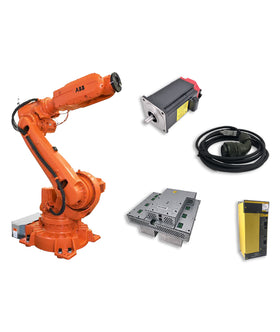
Key components commonly involved in issues and replacements.


{"one"=>"Selecione 2 ou 3 itens para comparar", "other"=>"{{ count }} de 3 itens selecionados"}
Selecione o primeiro item para comparar
Selecione o segundo item para comparar
Selecione o terceiro item para comparar
Deixe um comentário