



When a Universal Robots system repeatedly enters Protective Stop, the issue is rarely a direct robot hardware failure.
In most industrial environments, Protective Stop is triggered because the controller detects instability in:
Protective Stop is a predictive safety response, not a random shutdown.
The controller halts motion before the robot reaches a potentially unsafe operating condition.
In real production cells, successful troubleshooting requires analyzing three critical layers simultaneously:
A Protective Stop is a controlled safety reaction generated by the UR controller when it predicts unsafe motion behavior or detects instability in the safety system.
Unlike a critical fault:
The robot simply stops motion execution while maintaining a recoverable safe state.
The purpose is straightforward:
Typical behavior:
This usually indicates:
The robot consistently stops:
This strongly suggests:
No mechanical impact occurs, yet the stop triggers.
This is extremely common in UR systems because the controller predicts unsafe conditions before physical contact happens.
Common triggers include:
A reboot temporarily clears the issue, but the stop returns later under production load.
This is usually a sign of:
Protective Stop is almost never caused by a single factor. In field diagnostics, it usually comes from multi-layer interaction issues.
This is the most common root cause in integrated automation environments.
Even extremely short interruptions in the safety chain can trigger Protective Stop.
Key field insight:
In industrial safety systems, even millisecond-level signal drops are sufficient to trigger a stop condition.
The robot may appear mechanically stable while the controller reacts to unstable safety logic.
UR controllers continuously calculate whether robot motion remains inside safe dynamic limits.
If predicted motion exceeds the allowed safety envelope, Protective Stop activates even without collision.
Key diagnostic point:
This is not external failure — The controller is rejecting motion because the predicted dynamics exceed safe operating conditions.
One of the most underestimated causes in real production environments.
Common issues:
UR safety calculations depend heavily on accurate payload modeling.
If payload or CoG values are wrong:
Many “random” Protective Stops disappear immediately after proper payload recalibration.
The robot itself may be healthy while surrounding automation systems introduce instability.
Protective Stop occurs only during integrated automatic operation — not in manual jogging.
This strongly points toward external automation interaction issues.
Electrical interference is frequently overlooked during diagnostics.
These conditions can generate false safety transitions interpreted by the controller as unsafe events.
Even without external safety issues, poor robot programming alone can trigger Protective Stop.
The system stops motion preemptively when trajectory prediction becomes unstable.

Never diagnose Protective Stop by assumption alone.
Always confirm the trigger source using logs.
Go to:
PolyScope → Log Tab → Safety Events
Check for:
Determine:
Based on industrial field diagnostics, Protective Stop causes are commonly distributed as:
| Cause | Approximate Frequency |
| Safety I/O instability | 50% |
| Payload / CoG mismatch | 25% |
| Motion envelope violations | 15% |
| PLC or electrical interference | 10% |
Protective Stop is rarely caused by controller hardware failure.
Most cases originate from:
Incorrect payload and CoG settings are among the highest-frequency causes of recurring stops.
In integrated cells, external systems are often the real trigger:
UR Protective Stop is a predictive safety mechanism driven by real-time system modeling.
It activates when one or more of the following become unstable:
The robot is not necessarily “broken.”
The controller is preventing unsafe operation before damage or collision occurs.
If a UR robot repeatedly enters Protective Stop, troubleshoot in this order:
Most cases come from safety signal instability or motion envelope violations, not hardware failure.
The most common causes are:
It is rarely a controller hardware failure.
No. Protective Stop is a preventive safety response designed to stop unsafe motion before mechanical damage or collision occurs.
Yes. It is one of the most common causes in production environments.
Incorrect payload leads to:
Use:
PolyScope → Log Tab → Safety Events
Check:
Logs typically reveal whether the trigger originated from motion dynamics or external safety logic.
Explore the Full Guide: Industrial Robot Knowledge Hub → Repair & Troubleshooting Cluster
Explore the complete guide for troubleshooting, repair strategies, and component replacement across industrial robot systems.
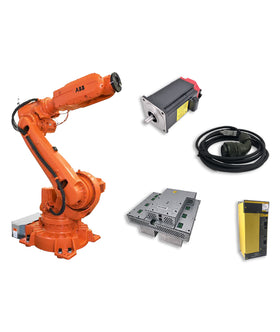
Key components commonly involved in ur protective stop issues and replacements.


{"one"=>"Selecione 2 ou 3 itens para comparar", "other"=>"{{ count }} de 3 itens selecionados"}
Selecione o primeiro item para comparar
Selecione o segundo item para comparar
Selecione o terceiro item para comparar
Deixe um comentário