


A System Communication Timeout is one of the most common industrial robot faults — and also one of the most misunderstood.
Many technicians initially suspect the controller, servo drive, or robot software. In actual production environments, however, timeout faults are far more likely to originate from unstable signal transmission somewhere inside the robot communication system.
In many cases, the real trigger is far simpler:
This guide explains how timeout faults develop, why they often appear intermittently, and how to isolate the real root cause before replacing expensive components unnecessarily.

Industrial robots rely on deterministic real-time communication between multiple subsystems:
A timeout occurs when expected data is not received within the required communication cycle.
Typical timeout conditions include:
Unlike standard office networks, robot communication systems operate within extremely tight timing tolerances. Even very small signal disturbances can stop robot motion or generate servo alarms.
One of the strongest diagnostic clues is that timeout faults often become worse during robot movement.
Typical symptoms include:
This behavior matters because true controller failures are usually consistent and repeatable.
Intermittent, motion-related faults are far more likely to indicate:
One reason these faults are difficult to diagnose is that the robot may recover temporarily after rebooting.
This often leads technicians toward:
However, restarting the system only resets the communication cycle temporarily.
It does not repair the underlying signal instability.
In real production environments, timeout faults are commonly linked to:
A communication timeout is rarely a single-component failure.
It is usually a chain reaction across multiple signal layers.
This layer includes:
Because these components move continuously, they experience:
Even when the outer jacket looks normal, internal conductors may already be damaged.
Robot cables operate in one of the harshest electrical environments in industrial automation.
Over time, repeated motion can cause:
Typical early-stage symptoms include:
As degradation progresses, communication timeouts become more frequent.
This is why experienced technicians often inspect the cable system first before replacing drives or controllers.
This layer handles real-time position feedback between the robot motor and controller.
Depending on the robot platform, this may include:
When feedback signals become unstable, the controller may lose synchronization with actual motor position.
Common symptoms include:
Modern industrial robots rely on high-speed communication between:
Examples include:
If lower-layer signal instability persists, communication timing errors eventually propagate into the drive layer and trigger timeout alarms.
ABB systems rely heavily on stable encoder communication and shielding integrity.
Common failure areas include:
Timeout faults often become worse during high-speed motion or long production cycles.
Specific review of ABB system communication timeout troubleshooting
KUKA robots use:
These systems are highly sensitive to:
Motion-related timeout faults are especially common in high-flex axis areas.
Specific review of KUKA system communication timeout troubleshooting
FANUC systems commonly experience timeout-related faults within the FSSB communication architecture.
Typical associated alarms include:
Common causes include:
Specific review of FANUC system communication timeout troubleshooting
Yaskawa robots use serial encoder communication integrated with Sigma servo architecture.
Timeout conditions are commonly linked to:
Specific review of Yaskawa system communication timeout troubleshooting
Focus on:
Look for:
Perform slow-speed testing across the full robot range.
Questions to verify:
Position-dependent behavior strongly suggests cable or feedback instability.
Check:
Even short signal interruptions can generate timeout alarms.
Monitor:
Many intermittent timeout faults are caused by poor electrical continuity.
Inspect for:
Once signal instability is confirmed, the most effective repair is usually:
This may involve:
In real industrial environments, this resolves the majority of intermittent timeout faults.
After repairs, verify:
In many real-world robot failures, communication timeout alarms are symptoms rather than root causes.
When the fault changes with:
the issue is often related to signal integrity somewhere in the communication path.
Across ABB, KUKA, FANUC, and Yaskawa systems, experienced technicians typically inspect:
before replacing controllers, servo drives, or other high-cost hardware.
No. In many industrial cases, the root cause is unstable communication caused by cable fatigue, feedback interruption, or shielding degradation.
Restarting resets the communication cycle and temporarily restores synchronization, but the underlying signal instability remains.
Yes. Internal conductor fatigue frequently causes random or position-dependent communication failures.
Usually not. Cable systems, feedback loops, and communication integrity should be inspected before replacing high-cost electronic components.
A System Communication Timeout is rarely a simple single-component failure.
In most industrial robots, it is a multi-layer signal integrity problem involving:
The most effective diagnostic path is:
Robot Cables → Feedback System → Drive Communication Layer
In real industrial environments, stabilizing the physical signal layer resolves the majority of timeout-related robot faults quickly and cost-effectively.
Explore the Full Guide: Industrial Robot Knowledge Hub → Repair & Troubleshooting Cluster
Explore the complete guide for troubleshooting, repair strategies, and component replacement across industrial robot systems.
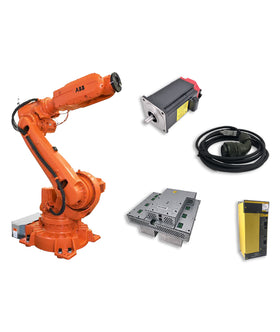
Key components commonly involved in system communication imeout issues and replacements.
No related parts found. Please check available components in our catalog.


{"one"=>"Selecione 2 ou 3 itens para comparar", "other"=>"{{ count }} de 3 itens selecionados"}
Selecione o primeiro item para comparar
Selecione o segundo item para comparar
Selecione o terceiro item para comparar
Deixe um comentário