



Axis drift in FANUC robots usually does not start as an obvious failure.
In many production environments, the robot appears to be running normally, while position accuracy slowly begins to deviate over time.
At first, operators often suspect servo tuning or minor mechanical wear. In some cases, the robot even seems fine again after a restart or re-home operation. But when the same deviation keeps returning during production, the issue is usually not mechanical.
In FANUC systems, axis accuracy depends on continuous coordination between:
If any part of this loop becomes unstable, small positioning errors start to accumulate during motion cycles.
Over time, this becomes what is commonly observed in the field as axis drift.
Pulse Coder → FSSB Communication → Servo Controller Model → Motion Output
When the feedback chain is not fully stable:
This type of deviation is not immediate. It builds slowly during operation, which is why it is often noticed late in production.
In real production cases, axis drift rarely appears as a single alarm event.
More often, it looks like a gradual loss of accuracy:
A common field observation is this pattern:
The robot looks normal after restart → runs fine for a while → then the same offset returns again.
This cycle is a strong indicator that the issue is not purely mechanical.
Axis drift is often accompanied by servo-related alarms, but not always in a direct or obvious way.
This alarm indicates loss or instability of absolute position data.
In real field cases, it can lead to:
It is often misunderstood as a simple battery issue, but in practice it may expose deeper reference instability.
This alarm points to abnormal pulse counting behavior.
In practice, it usually means:
Triggered when servo feedback deviates too far from the motion model.
Typical meaning:
When these alarms appear together or intermittently, it usually indicates:
Not a single-point mechanical failure.
In FANUC robots, Pulse Coder is built directly into the αi servo motor and plays a central role in position feedback.
When it starts degrading:
The effect is slow but continuous.
Over time, this leads to:
In many real maintenance cases, everything else looks normal until this layer is inspected closely.
Inside the Pulse Coder, position is read through a high-precision optical system.
In industrial environments, contamination is not rare:
What makes this tricky is that the robot can still run normally at low speed.
But during high-speed motion:
This is usually a gradual degradation, not a sudden failure.
FSSB is responsible for transmitting feedback signals from servo to controller.
When instability appears:
A typical pattern seen in production:
This motion-dependent behavior is often a key diagnostic clue.
Mechanical wear usually does not generate drift alone, but it can make existing issues more visible.
Common contributors:
In practice, mechanical issues often amplify a feedback problem rather than replace it as the root cause.
Check whether:
If yes, feedback instability is more likely than mechanical failure.
Look for patterns in:
Not the single alarm, but the pattern matters.
Focus on:
Thermal drift is often a key clue here.
Inspect:
Motion-only drift usually points here.
Verify:
This step confirms, not leads.
If drift continues after recalibration, it is usually not a tuning issue anymore.
In most industrial cases, the real corrective direction is restoring feedback integrity at the Pulse Coder level.
This typically involves encoder or feedback system replacement to re-establish accurate position tracking between:
System result:
Since Pulse Coder is integrated into the αi motor, internal degradation cannot always be isolated.
When failure is internal:
System-level benefits:
One key field clue:
If accuracy temporarily returns after restart but slowly degrades again, the problem is almost always inside the feedback layer.
Axis drift is not unique to FANUC.
Similar behavior can be seen in:
Because all industrial robots rely on:
So in real engineering environments, axis drift is treated as a general feedback system degradation pattern, not a brand-specific issue.
Usually no. Most cases are related to feedback instability, not parameter tuning.
Because unstable voltage or reference loss affects position recovery after restart.
Yes. Even very small contamination can disrupt pulse reading stability.
Because feedback errors accumulate gradually during continuous operation.
Explore the Full Guide: Repair & Troubleshooting Cluster → Industrial Robot Axis Drift Problem
Explore the complete guide for troubleshooting, repair strategies, and component replacement across industrial robot systems.
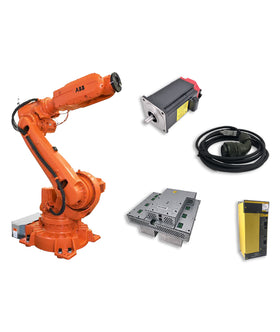
Key components commonly involved in industrial robot axis drift problem issues and replacements.


{"one"=>"Selecione 2 ou 3 itens para comparar", "other"=>"{{ count }} de 3 itens selecionados"}
Selecione o primeiro item para comparar
Selecione o segundo item para comparar
Selecione o terceiro item para comparar
Deixe um comentário