

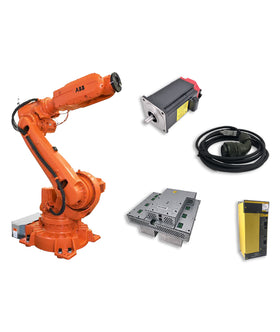

A robot dresspack is responsible for protecting and routing power cables, encoder cables, communication lines, and pneumatic hoses throughout continuous robotic motion.
Unlike stationary cable systems, dresspacks operate under constant bending, twisting, vibration, and environmental exposure. Over time, these forces gradually degrade cable assemblies and increase the risk of signal instability, communication faults, and unexpected downtime.
Preventive maintenance helps identify wear before failures occur, extending cable service life and improving robot reliability.
For high-duty-cycle applications such as welding, material handling, packaging, and machine tending, a structured dresspack maintenance program can significantly reduce repair costs and production interruptions.
Dresspack failures rarely occur without warning.
Most failures develop through a gradual progression:
Without preventive maintenance, these issues often remain hidden until they trigger servo alarms, encoder communication errors, or network failures.
The goal of preventive maintenance is not simply to repair damage but to reduce stress accumulation before it reaches a critical level.

Understanding the primary failure mechanisms helps maintenance teams focus inspections on the areas most likely to develop problems.
Repeated wrist rotation generates continuous twisting forces within cable bundles.
Over time this may lead to :
When cables repeatedly flex below their recommended bend radius, mechanical fatigue accelerates.
Potential consequences include:
In welding, machining, and dusty production environments, abrasive particles can damage cable jackets and protective conduit systems.
Connector-related failures often result from:
Effective maintenance focuses on high-stress areas rather than performing only general visual inspections.
Critical inspection zones include:
Check for excessive bending and cable compression.
Inspect for torsional fatigue, conduit damage, and cable twisting.
Verify proper strain relief and cable support.
Look for abrasion, rubbing, and routing issues.
Inspect areas exposed to frequent flexing and repetitive motion.
Routine inspections should combine visual checks with mechanical verification.
Look for:
Confirm:
Move the robot through its operating range and observe:
Dresspack-related issues often become visible only during motion.
The wrist area is typically the highest-stress section of any robot dresspack.
These axes experience:
As a result, most cable fatigue failures originate in this region.
Maintenance personnel should pay particular attention to:
Frequent inspection of Axis 4–6 routing can prevent many unexpected cable failures.
One useful maintenance practice is restoring the cable system to a neutral torsional state.
Consider a reset when:
A torsional reset may help:
Always follow robot and dresspack manufacturer recommendations when performing this procedure.
Visual inspection alone cannot identify many internal cable failures.
Electrical diagnostics help detect degradation before functional failures occur.
Checks for conductor breaks and intermittent connections.
Evaluates shielding performance and grounding continuity.
Helps identify insulation degradation caused by mechanical fatigue, moisture, or contamination.
Monitor:
Increasing communication errors often indicate early cable degradation.
Time-Domain Reflectometry (TDR) can help locate:
TDR is particularly useful for troubleshooting intermittent faults that are difficult to reproduce.
Maintenance intervals should be based primarily on operating hours and motion exposure rather than calendar time.
| Maintenance Activity | Recommended Interval |
| Visual inspection | Every 250 run-hours |
| Clamp verification and routing check | Every 1,000 run-hours |
| Torsional inspection and adjustment | Every 1,000 run-hours |
| Electrical diagnostics | Every 4,000 run-hours |
| Lifecycle evaluation | Every 8,000–12,000 run-hours |
Actual intervals should be adjusted based on robot duty cycle and environmental conditions.
Replacement decisions should not rely solely on visible damage.
Consider replacement when:
By the time frequent signal instability appears, cable degradation is often already well advanced.
Replacing a worn dresspack proactively is usually less expensive than dealing with unplanned production downtime.
Many facilities are moving beyond fixed maintenance intervals and adopting predictive maintenance strategies.
Useful monitoring indicators include:
These data points help maintenance teams identify dresspacks approaching the end of their service life before failures occur.
Predictive maintenance is particularly valuable for:
Dresspack reliability is closely connected to several other robot cable systems.
Provides position and speed feedback from servo motors.
Supports closed-loop motion control.
Supplies electrical power to robot axes and tooling.
Supports EtherCAT, PROFINET, and Ethernet/IP communication.
Often used alongside dresspacks in applications requiring linear cable movement.
Dresspack preventive maintenance is a structured inspection and maintenance program designed to reduce cable stress, identify wear early, and prevent unexpected failures.
Repeated twisting causes conductor fatigue and shielding degradation, which can eventually lead to signal instability and communication faults.
TDR helps locate conductor breaks, shielding damage, and impedance discontinuities before they become functional failures.
Dresspack wear is primarily driven by motion exposure rather than age, making run-hours a more accurate maintenance metric.
No maintenance program can eliminate all failures, but regular inspections and diagnostics can significantly reduce the likelihood of unplanned downtime.
Key components commonly involved in issues and replacements.
No related parts found. Please check available components in our catalog.


{"one"=>"Selecione 2 ou 3 itens para comparar", "other"=>"{{ count }} de 3 itens selecionados"}
Selecione o primeiro item para comparar
Selecione o segundo item para comparar
Selecione o terceiro item para comparar
Deixe um comentário