
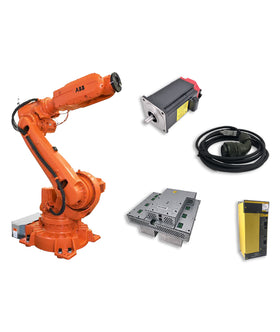


Industrial robots are the backbone of modern manufacturing, driving productivity, precision, and safety across sectors. But their performance depends heavily on how they're programmed. Today, three main robot programming techniques are widely used: Teach Pendants, Offline Programming (OLP), and Lead-Through Programming. Each method serves different production needs, from high-speed automotive assembly to flexible low-volume customization.
In this guide, we’ll break down how these methods work, their pros and cons, and how they shape the future of industrial automation.
Teach Pendants are handheld interfaces that let operators program robots directly. Using buttons and joystick controls—or even touchscreens—users guide the robot through specific motions, which are recorded as commands.
This "teaching by demonstration" approach is highly intuitive. It’s especially valuable for operators without advanced coding skills, as the robot can be shown what to do in real time.
Simple and operator-friendly
Great for repetitive tasks
Quick to adjust on the fly
Robot must be offline during teaching
Setup is time-consuming for complex motions
Less suitable for high-mix, low-volume production
Use case: Assembly lines or welding operations, where routines rarely change and downtime can be planned. Besides, robotic arms rely heavily on teach pendants for setup, testing, and real-time control, even as smarter and more intuitive programming tools are evolving. Brands such as Yaskawa (Motoman teach pendant), FANUC iPendant, ABB, KUKA smartpad, and Kawasaki all provide teach pendants for their robotic arms, often with model-specific interfaces.

Offline Programming (OLP) involves creating and testing robot code in a virtual 3D environment—without interrupting production. Engineers use CAD models and simulation software to plan paths, detect collisions, and optimize cycle times.
Once the program is finalized, it’s uploaded to the robot, allowing seamless transitions from design to execution.
No disruption to live production
Enables precise, complex path planning
Collaborative and scalable across teams
Requires specialized software and skilled personnel
Virtual-real world discrepancies may require fine-tuning
Higher initial investment
Use case: Aerospace, automotive, or any industry where precision and uptime are critical.

Lead-Through Programming, or hand-guiding, lets operators physically move the robot into desired positions. Built-in sensors capture the motion path, turning it into executable code.
This technique is great for intuitive learning or one-off tasks, and is commonly used during prototyping or in R&D.
Highly intuitive and tactile
Fast setup for small batches
No need for programming interfaces
Limited precision for high-speed tasks
Not scalable for complex or heavy robots
Potential safety concerns
Use case: Custom fabrication, prototyping, or short-run manufacturing where adaptability is key.
Absolutely. Hybrid programming approaches are increasingly common. Many manufacturers use OLP for main workflows, Teach Pendants for in-situ adjustments, and Lead-Through for irregular or one-time tasks.
Example:
A car manufacturer uses OLP for precise welding patterns
Technicians use a Teach Pendant to fine-tune alignment
A Lead-Through session adapts the robot to a new fixture design
This mix enables companies to stay agile without sacrificing precision or uptime.
Each programming method aligns with different industrial needs:
Automotive: Teach Pendants dominate for welding, sealing, and painting
Aerospace: OLP is preferred for drilling, cutting, and high-accuracy tasks
Warehousing & Logistics: Lead-Through supports dynamic layouts and palletizing
Electronics: Hybrid approaches allow for both precision and flexibility
Job Shops & Fabricators: Lead-Through and Teach Pendants are ideal for custom jobs

Teach Pendants improve safety by keeping robots static during programming.
OLP reduces on-floor errors by simulating hazards before execution.
Lead-Through, while intuitive, requires safety safeguards due to manual handling.
From an efficiency perspective:
OLP maximizes uptime (up to 95%) by enabling programming during production
Teach Pendants suit repetitive but lower-complexity tasks (~80% uptime)
Lead-Through boosts flexibility but isn’t ideal for scalability
Bottom line: The right method depends on the task’s complexity, volume, and risk profile.
The way you program a robot determines how well it fits into your production line. Whether you prioritize speed, safety, or adaptability, each method—Teach Pendants, Offline Programming, and Lead-Through Programming—brings its own strengths.
In most real-world scenarios, a hybrid model offers the best of all worlds, allowing manufacturers to stay competitive, agile, and efficient in an evolving automation landscape.
A: Lead-Through Programming is ideal thanks to its flexibility and ease of use.
A: Not fully. OLP is efficient, but Teach Pendants are still vital for fine-tuning and simple routines.
A: AI augments traditional methods by enabling adaptive behaviors, predictive pathing, and real-time optimization.
Explore the Full Guide: Industrial Automation System Cluster →
Explore foundational knowledge and practical insights to better understand industrial robot systems and components.
Key components commonly involved in automation systems issues and replacements.


{"one"=>"Selecione 2 ou 3 itens para comparar", "other"=>"{{ count }} de 3 itens selecionados"}
Selecione o primeiro item para comparar
Selecione o segundo item para comparar
Selecione o terceiro item para comparar
Deixe um comentário