

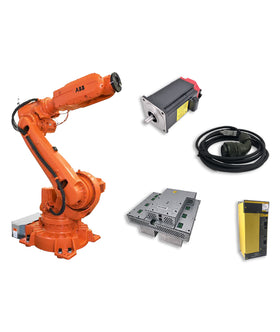
Servo drives (servo amplifiers) are the "muscles" of a robotic system. They convert DC bus voltage into precisely regulated current to manage motor torque, speed, and positioning. When a drive fails, the robot enters Servo Off status, halting production instantly.
This index provides a structured technical reference for ABB, Fanuc, KUKA, and Yaskawa drive modules, focusing on part identification, failure diagnostics, and sourcing strategies.
1.Why Servo Drives Are Critical in Industrial Robots
A high-functioning servo amplifier is essential for:
- Path Accuracy: Maintaining sub-millimeter precision during high-speed motion.
- Dynamic Torque: Managing heavy payloads without "droop" or overshoot.
- Thermal Stability: Preventing heat-related shutdowns in high-cycle environments.
- System Longevity: Protecting motors and gearboxes from erratic current spikes.
Pro Tip:Early replacement of aging capacitors or fans prevents catastrophic failure of the IGBT (Insulated-Gate Bipolar Transistor) power stage.
2. Drive Technology Categories
2.1️ AC Servo Drives (Mainstream Industrial Robots)
- Three-phase AC architecture
- Closed-loop position, speed, torque control
- Used in multi-axis articulated robots
Found in most systems from ABB Robotics, FANUC, KUKA, and Yaskawa Motoman.
2️.2 DC Servo Drives (Legacy Platforms)
- Older generation control architecture
- Found in early robot models
- Still common in long-running automotive lines
Often replaced during controller retrofits.
2.3️ Integrated Drive Modules
- Shared DC bus systems
- Multi-axis compact drive packs
- Used in modern high-density control cabinets
Common in newer controller generations with modular power distribution.
| Category | Application | Status |
|---|---|---|
| AC Servo Drives | 3-Phase closed-loop control for articulated robots. | Industry Standard |
| DC Servo Drives | Legacy brushed motor control (Early Fanuc/Motoman). | Legacy / Retrofit |
| Integrated Modules | Multi-axis "drive packs" with shared DC buses (KRC4/IRC5). | Modern / Compact |
3. Multi-Axis Drive Directory by Brand
ABB Robotics: IRC5 & OmniCore Modules
ABB utilizes modular drive systems (DSQC series) that are often grouped into "Drive Units" containing multiple axis amplifiers.
- 3HAC028357-001: Standard IRC5 Drive Module.
- 3HAC044168-001 (DSQC 1003): High-efficiency servo drive for IRB series.
- 3HAC034793-001: Compact axis drive optimized for the OmniCore platform.
Used with IRC5 and OmniCore controllers in IRB series robots.
Typical ABB alarm triggers:
- 38031 Overcurrent
- 38200 DC Link fault
- 50056 Drive temperature high
FANUC Servo Amplifiers – αi / βi Series
Fanuc drives are known for their "FSSB" (Fanuc Serial Servo Bus) connectivity.
- A06B-6120-H102: Common Main Axis drive for R-30iB systems.
- A06B-6121-H103: Wrist axis amplifier for 6-axis control.
- A06B-6240-H105: Latest generation αi-B series servo amplifier.
Common Fanuc faults:
- SV041 Excess current
- DCAL alarm
- Fan failure detection
⚠ Suffix differences (H102 vs H103) usually indicate current rating differences.
KUKA: KSP & KPP Modules (KRC4)
KUKA KRC4 controllers use integrated Power Packs (KPP) and Servo Packs (KSP) that utilize a shared DC bus.
- 00-104-755: KUKA KSP Axis Drive Module (20A/40A/64A variants).
- 00-132-354: Integrated KPP Power Pack/Drive combination.
- 00-106-880: Wrist-specific servo drive module for small KR robots.
Frequent KUKA issues:
- DSE-IBS temperature alarms
- DC bus undervoltage
- Internal fan failure
Yaskawa Motoman: Sigma-7 Architecture
Yaskawa drives are highly integrated, combining high-speed DSPs with high-performance power stages.
- SGD7S-550A01A: 5.5kW medium-payload axis drive for Sigma-7 systems.
- SGD7S-750A01A: High-payload (7.5kW) primary axis drive.
- SGD7S-550A01B: Specialist wrist-axis drive with enhanced vibration suppression.
Known for:
- Smooth vibration suppression
- Compact footprint
- Strong thermal stability
4. Diagnostics: Correlating Alarms to Hardware
Use this table to determine if a drive requires immediate replacement.
| Symptom / Alarm | Probable Fault | Technical Root Cause |
|---|---|---|
| Overcurrent (OC / HCAL) | Power Stage | Shorted IGBT or motor winding insulation breakdown. |
| Undervoltage / DC Link | Power Supply | Aging capacitors or faulty input bridge rectifier. |
| Overtemperature (OH) | Thermal Path | Blocked heatsinks or failing internal cooling fans. |
| Feedback Error (FBE) | Signal Interface | Faulty encoder processing circuit on the control board. |
| Regenerative Failure | Brake Circuit | Failed brake resistor or "Back-EMF" dissipation circuit. |
4. Maintenance Strategy: Refurbished vs. New
Because servo drives contain high-wear components (fans and electrolytic capacitors), sourcing strategy is vital.
- New OEM: Best for systems under factory warranty or critical ISO-certified lines.
- Verified Refurbished: A high-value alternative for legacy systems (e.g., Fanuc R-J3iB or KUKA KRC2).
- The Load-Test Requirement: Neverinstall a drive that hasn't been dynamically load-tested. Our refurbished units are tested under full-rated current to ensure the IGBTs can handle the "In-Rush" of a rapid robot move.
5. Failure Signs & Replacement Timing
Servo drives should be inspected or replaced when:
- Alarm codes are frequent (overcurrent, overvoltage, overtemperature)
- Axis motion is unstable, jittery, or noisy
- Servo motors overheat despite normal operation
- Drive modules are physically damaged or fan/filter airflow is blocked
Timely replacement prevents servo motor damage, production downtime, and long-term mechanical stress.
6. Integrated Maintenance Resources
To support a full motion-system overhaul, reference these specialized indexes:
- Robot Servo Motors & Encoders Index
- Robot Drive Cooling Fans & Filters Index
- Robot Gearboxes & Reducers Index
- Robot Axis Harness & Motor Cables
- Robot Controller Repair Parts Index
FAQ C Robot Servo Drives
Q: Can I swap two drives if they have the same part number but different suffixes?
A: Use caution. A different suffix (e.g., -H102 vs. -H103) often indicates a different Current Rating (Amps). Installing a lower-rated drive on a high-torque axis will lead to immediate Overcurrent alarms.
Q: My drive is running hot, but there are no alarms yet. What should I do?
A: Replace the Internal Cooling Fan and clean the Heatsink Fins. Servo drives are "Thermal-Limited"heat is the #1 cause of capacitor aging and eventual PCB failure.
Q: Do I need to reload parameters after replacing a drive?
A: In most modern systems (Fanuc FSSB or KUKA KRC4), the parameters are stored in the CPU and "pushed" to the drive upon startup. However, you may need to re-master the axes if the drive change triggers a pulse-coder reset