

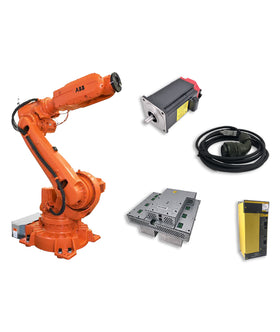

Industrial robots operate in environments filled with electromagnetic interference (EMI). Servo drives, welding equipment, inverters, motors, and high-current switching devices continuously generate electrical noise that can interfere with sensitive robot signals.
To protect these signals, robot cables use shielding layers designed to block interference and maintain signal integrity.
When shielding becomes damaged, degraded, or improperly grounded, EMI can penetrate the cable and disrupt encoder feedback, communication networks, and servo control systems.
The result is often a series of intermittent and difficult-to-diagnose problems, including encoder alarms, communication timeouts, position drift, and unexpected robot downtime.
Understanding robot cable shielding failure is essential for maintaining reliable industrial automation systems.
Unlike broken conductors or short circuits, shielding failures rarely create obvious electrical faults.
Instead, they typically appear as unstable signal behavior.
Shield degradation can allow EMI to interfere with encoder signals, resulting in intermittent communication faults and synchronization errors.
Electrical noise entering feedback circuits may cause servo hunting, velocity oscillation, or unstable position correction.
Fieldbus networks such as EtherCAT, PROFINET, and CAN bus can experience packet loss, CRC errors, and temporary disconnections.
Feedback signal distortion can reduce positioning accuracy and create repeatability problems.
Noise-induced signal corruption often triggers alarms that appear unrelated to cable condition.
Temporary communication loss may force the controller into a protective shutdown.
| Robot Symptom | Possible Shielding Issue |
| Encoder Alarm | EMI entering feedback cable |
| Communication Timeout | Shield discontinuity |
| Servo Oscillation | Feedback signal distortion |
| Position Drift | Electromagnetic interference |
| CRC Errors | Reduced shielding effectiveness |
| Random Axis Fault | Poor grounding or damaged shield |
Because these symptoms are intermittent, shielding failures are frequently misdiagnosed as encoder faults, servo amplifier problems, or controller communication issues.
Robot cable shielding is not simply a protective layer wrapped around conductors.
Its purpose is to control how electromagnetic energy interacts with sensitive signal circuits.
Proper shielding helps:
Modern industrial communication protocols rely on stable signal transmission, including:
Without effective shielding, these systems become vulnerable to electrical noise.
Shielding degradation is usually a gradual process rather than a sudden failure.
Several factors contribute to long-term deterioration.
Robot wrist assemblies continuously twist and rotate cables.
Over time, this can cause:
Repeated flexing inside drag chains and robot joints can damage shielding layers.
Common effects include:
Elevated temperatures accelerate material degradation.
Heat can cause:
Many shielding failures occur at cable termination points.
Common problem areas include:
Even small discontinuities can create EMI entry points.
Oil, coolant, moisture, and chemical contamination gradually degrade shielding performance and connector integrity.
When shielding effectiveness decreases, electromagnetic interference can enter signal conductors through several mechanisms.
High-frequency voltage changes induce unwanted signals into nearby conductors.
Common causes include:
Typical symptoms:
Changing magnetic fields generate unwanted currents in nearby cables.
Common sources include:
Typical symptoms:
Ground potential differences can inject noise directly into communication systems.
This is often the most disruptive form of EMI because it affects the signal reference itself.
Typical symptoms:
Modern servo systems depend on precise feedback signals.
A simplified feedback loop consists of:
Encoder → Feedback Cable → Servo Amplifier → Motion Controller → Position Correction Loop
When EMI distorts encoder feedback, the servo controller receives inaccurate information about motor position and velocity.
The result can include:
In severe cases, the controller may generate synchronization alarms or stop robot motion entirely.
Shielding performance depends heavily on proper grounding.
Even high-quality shielded cables can become ineffective if grounding is poorly implemented.
A shield pigtail introduces inductance that increases impedance at high frequencies.
As frequency rises, the pigtail behaves less like a shield connection and more like an antenna.
This can:
For high-speed industrial communication systems, 360-degree shield termination is generally preferred.
Look for:
Verify:
Check for:
Useful for identifying:
Many shielding failures appear only during:
Testing during actual robot movement often reveals problems that static measurements miss.
Select cables designed for continuous bending and torsional motion.
Recommended features include:
Best practices include:
Implement:
Pay particular attention to:
Intermittent EMI-related faults often appear long before complete cable failure.
Proactive replacement can significantly reduce troubleshooting time and unplanned downtime.
Robot cable shielding failure is one of the most overlooked causes of encoder alarms, communication instability, servo oscillation, and intermittent robot faults.
Because shielding degradation typically develops gradually, problems often appear as random communication errors or motion instability rather than obvious cable damage.
By understanding how EMI enters robotic systems, recognizing the warning signs of shielding degradation, and implementing proper grounding and cable management practices, maintenance teams can significantly improve signal reliability and reduce costly production interruptions.
The most common causes are torsional fatigue, repeated bending, thermal aging, connector degradation, and improper grounding.
Yes. EMI entering encoder cables can disrupt feedback signals and generate intermittent communication alarms.
EMI conditions change continuously with robot movement, electrical load, switching activity, and cable position.
Transfer impedance measures how easily electromagnetic interference penetrates cable shielding. Lower ZT generally indicates better shielding performance.
Yes. PWM switching inside servo drives generates high-frequency noise that can interfere with nearby signal cables if shielding is compromised.
Use high-flex shielded cables, maintain proper grounding, separate power and signal routing, and inspect high-stress cable areas regularly.
Key components commonly involved in issues and replacements.
No related parts found. Please check available components in our catalog.


{"one"=>"比較する2つまたは3つのアイテムを選択します", "other"=>"選択された3つのアイテムの{{ count }}"}
コメントを残す