



Axis drift on ABB robots usually does not begin as a major failure.
In many production cells, the first sign is simply that the robot no longer returns to exactly the same point after several hours of operation. At the beginning, operators often assume the issue is related to calibration, tooling, or minor mechanical backlash. After rebooting the controller, accuracy may even appear normal again for a short period.
But when the offset keeps returning, the problem is often deeper inside the feedback system.
ABB robots depend on constant synchronization between encoder feedback, servo calculations, and SMB (Serial Measurement Board) position data. If the controller starts receiving unstable or inconsistent feedback information, positional deviation gradually accumulates during motion cycles.
This is why some robots can still run production while slowly losing TCP accuracy at the same time.
In actual field repair cases, progressive axis drift is frequently traced back to:
rather than a pure mechanical failure.
| Observed Symptom | Most Likely Cause | Priority Inspection Area |
| Drift increases over time | Encoder pulse inconsistency | Encoder feedback system |
| Robot misses accurate home return | SMB reference mismatch | SMB communication layer |
| Drift temporarily disappears after reboot | Feedback resynchronization | Encoder/SMB consistency |
| Deviation appears during movement only | Signal interruption | Robot cable system |
| Single-axis positional offset | Localized encoder degradation | Individual axis encoder |
Most ABB axis drift cases develop progressively rather than appearing instantly.
Common field symptoms include:
A pattern seen quite often in factories is this:
That behavior usually points toward unstable feedback synchronization rather than reducer wear or servo tuning problems.
Another important clue is that some drift conditions only appear while the robot is moving at production speed. During manual jogging or idle inspection, the system may appear completely normal.
Axis drift is commonly associated with ABB controller event logs such as:
These logs often indicate instability between:
Once synchronization quality begins deteriorating, the controller gradually loses confidence in true axis position.
The result is usually cumulative positional deviation rather than an immediate shutdown.
ABB robots rely on two separate but synchronized positioning references:
As encoder components age, pulse output can become unstable. At first the variation may be extremely small and almost impossible to detect during short operation cycles.
Over time, however, the mismatch accumulates.
Eventually the controller begins operating under a condition where:
Real-time encoder feedback ≠ SMB stored reference position
Once this happens, several symptoms may start appearing together:
In many repair situations, re-mastering temporarily improves accuracy because the positional reference gets reset. But once the unstable feedback continues accumulating, the deviation slowly returns.
This is why repeated recalibration often fails to permanently solve the issue.
Encoder signals are extremely sensitive to transmission quality.
In high-cycle robotic applications, cable degradation is one of the most overlooked causes of intermittent drift behavior.
Typical failure sources include:
Wrist axes (Axis 4–6) are especially vulnerable because those areas experience:
A common field situation is that the robot passes inspection while stationary, yet develops positional instability only during live production motion.
That usually points toward intermittent signal degradation rather than a permanent hardware failure.
Mechanical wear is often blamed first because it is easier to visualize physically.
Typical suspected causes include:
These factors can absolutely amplify positional instability.
However, in most real drift cases, mechanical wear alone is not sufficient to create continuous cumulative deviation unless an underlying feedback inconsistency already exists.
For this reason, replacing reducers before verifying encoder integrity often leads to unnecessary repair costs.
| Incorrect Assumption | Typical Result |
| Replacing servo amplifier first | Drift returns later |
| Adjusting servo tuning repeatedly | Temporary improvement only |
| Re-mastering multiple times | Offset gradually reappears |
| Assuming gearbox failure immediately | Unnecessary mechanical replacement |
| Ignoring encoder signal quality | Root cause remains unresolved |
One reason these cases are frequently misdiagnosed is that the robot may still operate “almost normally” during early-stage feedback degradation.
Check whether:
If reboot temporarily restores positional accuracy, encoder/SMB synchronization instability becomes highly likely.
Monitor:
In many cases, thermal-related encoder instability only becomes obvious after extended production cycles.
Pay special attention to:
Continuous motion testing is usually far more effective than static inspection because intermittent signal loss may only occur while the robot is moving.
Inspect:
Mechanical inspection should be treated as a confirmation layer, not the primary starting point of diagnos is.
When axis drift continues returning after recalibration, the problem usually exists inside the encoder feedback system rather than software offset data.
Many maintenance teams restore positional consistency by implementing robot encoder replacement solutions designed to rebuild stable synchronization between encoder output and controller reference data.
This corrective direction helps:
Stable encoder performance depends heavily on signal transmission integrity.
In many industrial environments, intermittent drift conditions are resolved by restoring feedback transmission stability through high-flex robot cable systems designed for continuous robotic motion.
This corrective approach helps:
On older ABB robot platforms, encoder degradation may affect the complete motor feedback structure rather than a single isolated component.
In these situations, maintenance teams often restore long-term motion reliability using ABB robot motor assemblies with integrated encoder systems designed to rebuildfullfull servo-loop feedback consistency.
This solution path helps:
Similar drift behavior also appears on:
because all industrial robot platforms ultimately depend on:
The alarm structures may differ between manufacturers, but the underlying engineering failure pattern is often nearly identical.
In real production environments, temporary recovery after reboot is often one of the strongest indicators that the failure exists in the signal-feedback layer rather than inside the reducer or gearbox itself.
Normally no. Most long-term drift cases are related to unstable encoder feedback consistency rather than incorrect servo parameters.
Recalibration resets positional reference values, but it does not repair unstable encoder pulse generation or signal degradation.
Yes. SMB corruption or unstable communication can affect stored position reference accuracy and gradually produce cumulative positional deviation.
Wrist axes (Axis 4–6) are usually the most vulnerable because they experience:
Heat buildup can increase encoder instability and worsen signal degradation, especially in aging feedback systems or damaged cable assemblies.
Explore the Full Guide: Repair & Troubleshooting Cluster → Industrial Robot Axis Drift Problem
Explore the complete guide for troubleshooting, repair strategies, and component replacement across industrial robot systems.
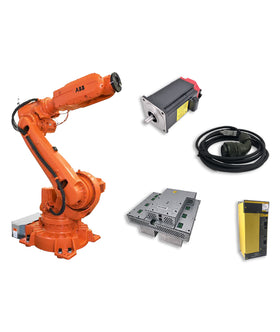
Key components commonly involved in industrial robot axis drift problem issues and replacements.


{"one"=>"比較する2つまたは3つのアイテムを選択します", "other"=>"選択された3つのアイテムの{{ count }}"}
コメントを残す