

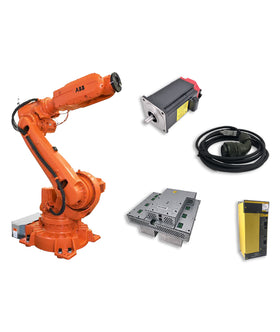

The rise of automation has transformed industries by boosting precision, efficiency, and flexibility. Among various industrial robots, the six-axis robot stands out due to its impressive range of motion and adaptability. But what exactly is a six-axis robot, and why is it so valuable in manufacturing and automation?
A six-axis robot is a robotic arm designed to mimic the movements of a human arm by moving along six degrees of freedom — three linear (x, y, z) and three rotational (roll, pitch, yaw). This capability enables the robot to perform complex, precise tasks in various manufacturing environments, making it a cornerstone technology in Industry 4.0.
Understanding the components of a six-axis robot helps clarify how it achieves such versatility:
Robot Base: The sturdy foundation fixed to the floor or workstation, housing the robot’s control unit and power supply.
Robot Arm: Multiple connected segments (links) that provide reach and flexibility, usually constructed from steel or aluminum.
Joints: Six rotating joints provide six degrees of freedom, allowing intricate movements.
Actuators: Typically servo motors that drive the joints.
Control System: The central “brain” that interprets programming commands and sensor feedback to direct precise motion.
End-Effector: The tool attached at the robot’s wrist (sixth joint), customized for tasks such as gripping, welding, painting, or inspection.

This axis, located at the robot base, allows the robot to rotate from left to right. This sweeping motion extends the work area to include the area on either side and behind the arm. This axis allows the robot to spin up to a full 180 degree range from the center point. This axis is also known as the Motoman : S and Fanuc: J1.
This axis allows the lower arm of the robot to extend forward and backward. It is the axis powering the movement of the entire lower arm. This axis is also known as the Motoman : L and Fanuc: J2.
The axis extends the robot's vertical reach. It allows the upper arm to raise and lower. On some articulated models, it allows the upper arm to reach behind the body, further expanding the work envelope. This axis gives the upper arm the better part access. This axis is also known as the Motoman : U and Fanuc: J3.
Working in conjunction with the axis 5, this axis aids in the positioning of the end effector and manipulation of the part. Known as the wrist roll, it rotates the upper arm in a circular motion moving parts between horizontal to vertical orientations. This axis is also known as the Motoman : R and Fanuc: J4.
This axis allows the wrist of the robot arm to tilt up and down. This axis is responsible for the pitch and yaw motion. The pitch, or bend, motion is up and down, much like opening and closing a box lid. Yaw moves left and right, like a door on hinges. This axis is also known as the Motoman : B and Fanuc: J5.
This is the wrist of the robot arm. It is responsible for a twisting motion, allowing it to rotate freely in a circular motion, both to position end effectors and to manipulate parts. It is usually capable of more than a 360 degree rotation in either a clockwise or counterclockwise direction. This axis is also known as the Motoman : T and Fanuc: J6.

With their flexibility and precision, six-axis robots are widely utilized across numerous industries, including manufacturing, healthcare, and even education. Here are some common applications:
One of the primary uses of six-axis industrial robots is in welding and assembly lines. Their ability to move in multiple directions enables them to precisely weld complex parts or assemble components that require accurate alignment. These robots are commonly employed in the automotive industry, where high precision and repeatability are of utmost importance.
Six-axis robots excel at material handling tasks, such as loading and unloading parts from machines, packaging products, and moving heavy or fragile objects. Their advanced motion capabilities ensure that materials are handled with care, thereby reducing the risk of damage or errors during the production process.
The flexibility of six-axis robots makes them ideal for tasks like painting and surface coating. Robots can follow complex paths while maintaining consistent speed and pressure, ensuring uniform application of paint or coatings across different surfaces. This is particularly crucial in industries where consistency is paramount, such as aerospace.
Pick-and-place operations involve selecting an object from one location and placing it in another. Small or miniature six-axis robots are often used in the electronics component manufacturing or pharmaceutical industries, where precise handling of tiny or fragile items is required. These robots can operate with extreme precision, ensuring minimal waste and defects.
Machine tending involves operating or supervising the functions of manufacturing machines, such as CNC machines, injection molding machines, or presses. Six-axis robotic arms can easily handle these tasks, such as loading raw materials, monitoring machine operations, and removing finished parts, thereby reducing downtime and improving production efficiency.
In industries where quality control is critical, six-axis robots equipped with sensors and cameras can inspect products for defects or inconsistencies. They can precisely move around products, ensuring thorough inspection from multiple angles, which is particularly useful in industries like electronics or pharmaceuticals.
Six-axis robots are so popular because they offer numerous advantages over other types of robots, including three-axis or four-axis robots. With their exceptional flexibility, precision, and efficiency, six-axis robots demonstrate significant advantages in industrial applications.
Six-axis robots have revolutionized automation across multiple industries, offering unprecedented flexibility, precision, and efficiency. Whether employed for welding, material handling, or inspection tasks, these robots enhance productivity while upholding high-quality standards.
From small-scale industrial robot arms to large-scale applications, the versatility of six- axis robots is undeniable. As an increasing number of industries recognize the benefits they bring, their usage will continue to grow.
A: Six axis robots have six degrees of freedom, allowing them to move in six different directions. This gives them greater flexibility and range of motion compared to other robot types, enabling them to perform more complex tasks and reach difficult angles.
A: Six axis robots are widely used in welding, painting, assembly, material handling, and quality inspection. They are particularly prevalent in automotive manufacturing, electronics assembly, and aerospace industries.
A: Six axis robots can be programmed using various methods, including teach pendants for manual guidance and recording of movements, and offline programming software for creating and simulating robot programs on a computer.
Explore the Full Guide: Industrial Robot Knowledge Hub → Industrial Robot Types & Applications Cluster
Explore foundational knowledge and practical insights to better understand industrial robot systems and components.
Key components commonly involved in robot applications issues and replacements.
No related parts found. Please check available components in our catalog.


{"one"=>"比較する2つまたは3つのアイテムを選択します", "other"=>"選択された3つのアイテムの{{ count }}"}
コメントを残す