

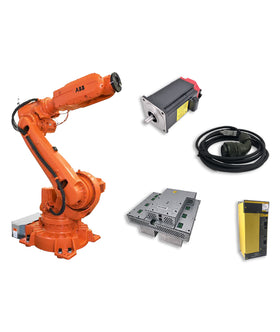
In modern automation, downtime is often measured in thousands of dollars per minute. The Robot Spare Parts Cross-Reference Hub is a professional-grade technical directory designed to help maintenance teams identify, verify, and source parts for ABB, Fanuc, KUKA, Yaskawa, and Universal Robots.
This hub specializes in cross-referencing high-cost OEM (Original Equipment Manufacturer) components with verified, industrial-grade compatible alternatives, with a specific focus on High-Flex Cable Systemsthe most common point of failure in robotic cells.
1. Sourcing Strategy: When to Choose OEM vs. Compatible
Selecting the right part type depends on the component's role within the robot's architecture.
| Part Type | OEM Advantages | Compatible Advantages | Notes |
|---|---|---|---|
| CPU / Main Board | Guaranteed compatibility, official support | Lower cost, faster delivery | Ensure firmware version matches |
| Servo Drive | Direct replacement, warranty | Lower price, may be faster | Verify electrical specs & connectors |
| Power Supply | Full reliability, tested by manufacturer | Cost-effective | Voltage/current must match |
| Safety / E-stop | Compliance guaranteed | Available from certified vendors | Regulatory compliance may require OEM |
| Harness / Cable | Exact fit, long-term reliability | Alternative length / custom options | Check pinout and connector type |
Field rule:
- Use OEM for safety-critical or firmware-dependent systems.
- Use high-quality compatible parts for wear items, legacy robots, or lead-time reduction.
2. Deep Dive: High-Flex Cable Systems
2.1 OEM vs. High-Flex Compatible Cable Performance
Robotic motion continuously subjects cables to tension, torsion, and abrasion.Enhanced compatible cables are engineered specifically for this moving environment.
| Feature / Specification | Standard OEM Cable | Enhanced High-Flex Compatible | Maintenance Impact |
|---|---|---|---|
| Jacket Material | PVC or Standard Grade Polyurethane | Premium PUR (Polyurethane) | Higher resistance to cutting oils, coolants, and weld spatter. |
| Internal Stranding | Standard Gauge Copper | Ultra-Fine Bare Copper Strands | Increased flexibility; prevents internal "fatigue breakage" during high-speed motion. |
| Bending Radius | ~10× diameter | ~6× diameter | Allows for tighter routing in compact robot cells without signal loss. |
| Torsion Rating | ±180°/m | ±360°/m | Essential for Axis 4-6 movement; prevents the "corkscrew" effect that kills internal wires. |
| Shielding Design | Single Layer Braided | Foil + braid double shield | Superior EMI/RFI protection, specifically in high-frequency welding environments. |
| Cycle Life Expectancy | 1-3 Million Bends | 5-10 Million Bends | Reduces the frequency of cable-related downtime by up to 200%. |
| Operating Temperature | 0 °C to +60 °C | −20 °C to +80 °C | Maintains flexibility in cold starts and high-heat foundry applications. |
While a CPU board stays protected inside a cabinet, the Cables and Dress Packs are in constant motion. They are the most frequently replaced "moving parts" in any robotic system.
2.2 Core Cable Categories
-
Cost Efficiency: OEM cables (e.g., Fanuc A660 series) often carry heavy markups. Verified compatibles offer 30-50% savingswithout sacrificing signal integrity.

- Lead Time: While OEM lead times can stretch to months, compatible high-flex cables are often stocked for immediate dispatch.
- Durability Upgrades: Many of our compatible cables utilize PUR (Polyurethane) jackets and finer copper stranding than standard OEM versions, offering better resistance to oils and torsion fatigue.
Core Cable Categories in the Hub:
| Cable Type | OEM Brand Reference | Key Cross-Reference Points |
|---|---|---|
| Pendant Cables | ABB 3HAC / Fanuc A660 | High-flexibility, oil-resistant PUR jacket, 10M/15M/20M lengths. |
| Main Power/Signal | KUKA X19 / Yaskawa CBL | Shielded twisted pairs to prevent EMI/RFI interference. |
| Internal Axis Cables | Fanuc i / ABB Internal | Torsion-rated (up to 360) for 1-6 axis internal routing. |
| Extension Cables | Universal Robots / ABB | Specialized connectors (Harting/Intercontec) for extending cell radius. |
2.3 Why Many Facilities Choose High-Flex Compatible Cables
Designed for continuous motion
Low-friction insulation materials reduce internal conductor wear during repeated bending.
Connector reliability
Factory-spec connectors such as Harting, Intercontec, or Hirose preserve mechanical and electrical integrity.
Stable encoder signal transmission
Short-pitch twisted pairs maintain communication accuracy even under torsion stress.
3. Controller-Level Component Cross-Reference
Beyond cables, we provide technical mapping for the entire controller ecosystem.
Logic & Control (CPU Boards)
- OEM Priority: High. Essential for systems requiring specific firmware handshaking.
-
Compatible Priority: Best for Legacy/EOL (End-of-Life) systems like ABB S4C+ or Fanuc R-J2.

Motion Control (Servo Drives & Motors)
- OEM Advantage: Factory-matched thermal profiles and torque constants.
- Compatible Advantage: Refurbished OEM units offer the reliability of original hardware at the price point of a compatible.
Human-Machine Interface (HMI)
- Components: LCD Panels, Touch Screen Digitizers, and Membrane Keypads.
- The "Hybrid" Strategy: Use a compatible High-Flex Cable with an OEM Teach Pendant to ensure the best balance of longevity and functionality.
4. Decision Matrix: When to Choose Compatible vs. OEM
5. How to Verify Compatibility
A part number match is only the first step. Our hub encourages a "Triple-Check" protocol:
- Electrical Mapping: Does the compatible cable or board match the voltage and pinout exactly
- Mechanical Fit: Does the connector (e.g., Harting, Hirose, or Intercontec) match the original interface
- Environmental Rating: For cables, does the compatible jacket (PVC vs. PUR) meet your facility's chemical exposure requirements
Frequently Asked Questions
Q: What is a cross-reference hub for robot parts?
A: Its a reference tool that helps you identify equivalent parts, both OEM and verified compatible, across multiple robot brands.
Q: Can I use compatible parts for production robots?
A: Yes, if the parts meet electrical, mechanical, and firmware specifications. For critical systems, OEM is recommended.
Q: How often are cross-reference databases updated?
A: Ideally, they should be updated whenever manufacturers release new firmware, revision levels, or part number changes.
Q: Do I need to verify compatibility even if the part number matches?
A: Yes. Confirm voltage, connector type, and firmware to avoid installation issues.
Q: Can I use a longer compatible cable than my original OEM cable?
A: Yes. We often cross-reference standard 7M cables with 10M or 15M high-flex versions to give operators more mobility without signal degradation, provided the shielding is industrial grade.
Q: Are compatible cables rated for high-interference welding environments?
A: Our cross-referenced welding cables feature double-shielded (braided + foil) designs specifically to handle high-frequency (HF) interference from robotic arc welders.
Q: How do I find the part number on a damaged cable?
A: Look for the printed text on the cable jacket or the tag near the connector. If it's illegible, send us a photo of the connector pins and the robot model; we can identify it via our cross-reference database.
Related Resources
- [Robot Controller Repair Parts Index] - Deep dive into controller components.
- [ABB OmniCore Controller Spare Parts Index] - OEM part numbers for ABB controllers.
- [Teach Pendant Compatibility Guide] - Verify pendant compatibility across brands.
-
[Robot Alarm Code Troubleshooting Hub] - Quickly identify controller or drive errors.