
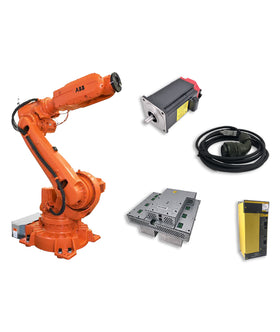
The precision of an industrial robot is only as reliable as its closed-loop feedback system. While the controller is the "brain," the Servo Motor and Encoder function as the "muscle" and "senses." Even a minor signal drift in a Fanuc Pulse Coder or a worn brake in an ABB motor can lead to path deviation, axis sag, or catastrophic collisions.
This technical index provides a cross-reference for ABB, Fanuc, KUKA, Yaskawa, and Mitsubishi motion components, helping maintenance teams identify, troubleshoot, and source critical axis hardware.

1. Why Servo Motors & Encoders Matter in Robotics
Servo systems are among the most failure sensitive and downtime critical components inside an industrial robot.Industrial robot motion depends on the coordination between:
- Servo motors - generate controlled rotational torque
- Encoders - provide precise position and speed feedback
- Servo drives - regulate motion based on feedback signals
When any part of this loop degrades, common symptoms include:
- Position deviation or path inaccuracy
- Axis vibration or abnormal noise
- Servo overload alarms
- Encoder communication faults
- Sudden E-stop during motion
- Axis sag after power loss
Because the system is closed-loop, even minor signal instability can halt an entire production cell.
2. Main Types of Robot Servo Motors & Encoders
2.1 AC Servo Motors
Most modern industrial robots use brushless AC servo motors designed for:
- High torque density
- Continuous duty operation
- Compact integration with reducers
- Integrated holding brakes
They are typically paired with absolute encoders to retain position data after shutdown.
2.2 Integrated Brake Motors
Vertical axes (Axis 2, Axis 3, wrist pitch) rely on electromagnetic holding brakes.
Brake failure can cause:
- Axis sag during power-off
- Unsafe vertical drop
- Position loss alarms
Brake wear is one of the most common long-term maintenance issues in high-cycle robots.
3. Encoder Types in Industrial Robots
Absolute Encoders
- Retain position without homing
- Require battery backup
- Loss of battery may require re-mastering
Incremental Encoders
- Require reference return after restart
- Simpler architecture
- Common in older platforms
if !supportLineBreakNewLine
Encoder-related failures often trigger:
- Position mismatch faults
- Encoder battery alarms
- Feedback loss errors
- SRVO or axis communication faults
4. Common Fault Symptoms & Root Causes
| Symptom | Probable Component | Root Cause |
|---|---|---|
| Position Deviation / Path Drift | Encoder / Resolver | Feedback signal instability or internal scale contamination. |
| Axis Drops/Sags During E-Stop | Integrated Brake | Mechanical wear of the friction discs or coil failure. |
| Abnormal Grinding / High Vibration | Motor Bearings | Lubrication breakdown or structural rotor imbalance. |
| Overcurrent or Isolation Error | Motor Windings | Insulation breakdown due to thermal aging or moisture ingress. |
| Encoder Battery Low | Absolute Encoder | Loss of revolution counter data; requires axis re-mastering. |
Fast identification prevents secondary damage to reducers, servo drives, or controller boards.
5. Servo Motors & Encoders by Brand
ABB Robot Servo Systems
ABB robots use axis-matched AC servo motors paired with high-resolution absolute encoders across IRC5 and OmniCore platforms.
Common part numbers include:
- 3HAC055437-004 C Servo motor assembly
- 3HAC021127-001 C Axis motor unit
- 3HAC17484-8 C Resolver / feedback module
Replacement typically requires correct axis matching and mastering procedures.
FANUC Servo Motors & Pulse Coders
FANUC systems use proprietary serial feedback integration with R-30i series controllers.
Typical components:
- A06B-0235-B605 C AC servo motor
- A06B-0127-B175 C Alpha series motor
- A860-0360-T001 C Pulse coder encoder
Common service triggers:
- SRVO alarms
- Excess servo load
- Encoder communication loss
KUKA Motion Architecture
KUKA platforms (KRC2 / KRC4) commonly integrate Siemens-based servo motors with digital encoders.
Example components:
- 1FK7103-5AF71-1UA0 C Servo motor (Siemens spec)
- 00-115-240 C Axis motor assembly
- 00-130-547 C Feedback / encoder component
Brake wear and encoder signal noise are frequent service causes in high-payload models.
Yaskawa / Motoman Servo Systems
Yaskawa Sigma-series motors are widely used in welding and handling applications.
Examples:
- SGM7J-04AFC6S C Sigma-7 servo motor
- SGMPH-02A1A C Motoman axis motor
- UTSAE-B17CL C Absolute encoder
Battery loss or encoder instability may affect absolute positioning accuracy.
6. Repair, Refurbishment, or Replacement
When Repair Is Feasible
- Bearing replacement
- Brake cleaning or coil replacement
- Encoder cable damage
- Minor contamination issues
When Full Replacement Is Required
- Stator winding burnout
- Magnet or rotor structural damage
- Internal encoder PCB failure
- Severe insulation breakdown
High-quality refurbished motorsproperly tested for insulation resistance, brake torque, and encoder signal stabilitycan provide significant cost savings compared to new OEM units.
7. Preventive Maintenance Best Practices
Extending servo life requires structured inspection:
Thermal Monitoring
Use infrared checks to detect abnormal heat rise compared to other axes.
Vibration Analysis
Early bearing failure is often detectable through increased vibration.
Cable Inspection
Encoder cable shielding damage is a leading cause of intermittent position jumps.
Battery Replacement
Replace absolute encoder batteries annually to avoid position loss and re-mastering downtime.
Spare Strategy
Keep critical axis motors or encoders in inventory for high-output production lines.
8. Frequently Asked Questions
Q: Can I swap a motor from Axis 1 to Axis 2 if the part numbers match?
A: Yes, but you must perform a "Mastering" or "Calibration" procedure. The robot controller stores specific encoder offsets for each axis; moving the motor resets these values.
Q: Why is my robot shaking during high-speed moves?
A: This is often "Servo Hunting." It usually points to a failing encoder that can no longer provide smooth feedback, or mechanical backlash in the gearbox that the motor is trying to compensate for.
Q: Are refurbished servo motors reliable?
A: If they are dynamically load-tested. Our refurbished units undergo insulation testing and encoder signal validation to ensure they meet original OEM torque curves.
Q: How long do servo motors last?
A: Typically 20,000C50,000+ operating hours depending on duty cycle and environment.
Q: What causes encoder failure most often?
A: Cable fatigue, electrical noise, battery depletion, or long-term thermal aging.
Related Technical Indexes
- [Robot Servo Drives & Amplifiers Master Index]
- [Robot Gearboxes & Precision Reducers Index]
- [Robot High-Flex Axis Harness & Motor Cable Index]
- [Robot Battery Packs & Backup Units Index]
Related Robot Spare Parts Indexes
To support complete motion-system maintenance, see also:
- Robot Servo Drives Master Index
- Robot Gearboxes & Reducers Index
- Robot Battery Packs & Backup Units Index
- Robot Maintenance Kits & Lubricants Index
- Robot Axis Harness & Motor Cables
- Robot Controller Repair Parts Index
These interconnected indexes form a complete diagnostic and replacement pathway for industrial robot motion systems.