
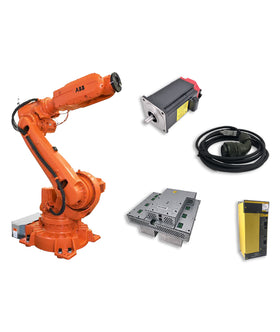

When a FANUC controller reports that a motor cannot be detected, the issue is often misdiagnosed as a servo motor failure.
In real production environments, this condition is most commonly caused by Pulse Coder feedback loss or FSSB communication instability, not mechanical motor damage.
FANUC motor detection depends entirely on stable encoder feedback transmitted through the FSSB network during startup initialization.
If this communication path is interrupted, the controller blocks servo enable and marks the axis as unavailable.
FANUC servo systems operate through a continuous high-speed feedback loop.
Signal Chain:
Pulse Coder → Servo Amplifier → FSSB Network → Controller
If any stage fails:
The motor is not physically failed — it is logically invisible due to missing feedback validation.
These alarms typically indicate:
In FANUC architecture, FSSB handles high-speed encoder data transmission between servo amplifiers and controller.
If FSSB integrity is lost:
Motor identity cannot be verified → axis is disabled
Without valid FSSB communication:
FANUC motors depend entirely on Pulse Coder feedback for operation.
Key principle:
A motor without valid FSSB feedback is treated as non-existent.
This leads to:
Encoder cables are one of the highest failure-rate components in FANUC systems.
Typical degradation mechanisms:
Result:
→ Intermittent Pulse Coder signal loss → motor detection failure
FSSB network issues may be caused by:
Multi-axis failure strongly indicates FSSB-level instability, not multiple motor failures.
Often overlooked but highly common:
Effect:
→ Intermittent encoder handshake failure during startup or motion
Check:
Multi-axis failure strongly indicates FSSB or shared communication issue
While system is safe:
If behavior changes with movement:
→ Internal cable fracture is highly likely
Motor side:
Amplifier side:
Inspect:
| Result | Diagnos is |
| Fault follows cable | Cable failure confirmed |
| Fault remains | Amplifier or motor issue |
| Fault intermittent | Progressive cable fatigue |
In real FANUC cases:
FANUC Pulse Coders rely on high-speed serial transmission.
Even minor signal degradation can:
Shielding quality is critical in noisy environments.
1. Can encoder cable failure damage the motor?
No. It mainly affects feedback and communication, not motor hardware.
2. Why does the motor disappear intermittently?
Because internal conductors are partially fractured and unstable under motion.
3. Can generic cables be used for Pulse Coder systems?
No. Incorrect impedance or shielding causes SRVO-062 / SRVO-068 alarms.
4. Does replacing the cable erase position data?
Usually no, if power-down and encoder backup conditions are normal.
5. Why do multiple axes fail at once?
This usually indicates FSSB or servo amplifier-level failure.
Explore the Full Guide: Repair & Troubleshooting Cluster → controller cannot detect motor
Explore the complete guide for troubleshooting, repair strategies, and component replacement across industrial robot systems.
Key components commonly involved in fanuc controller cannot detect motor issues and replacements.
No related parts found. Please check available components in our catalog.


{"one"=>"Seleccione 2 o 3 artículos para comparar", "other"=>"{{ count }} de 3 artículos seleccionados"}
Seleccione el primer artículo para comparar
Seleccione el segundo artículo para comparar
Seleccione el tercer elemento para comparar
Dejar un comentario