


A robot axis not moving condition is one of the most disruptive failures in industrial automation.
When a robot suddenly stops responding to jog commands or program motion, production can halt immediately, leading to costly downtime and unnecessary component replacement.
In many real-world maintenance cases, technicians initially suspect:
However, field service experience consistently shows that the most common root cause is not mechanical failure at all.
In a large percentage of cases, the issue originates from instability in the encoder feedback signal path, especially:
This troubleshooting guide helps engineers quickly isolate the actual failure source, reduce misdiagnos is, and restore robot motion efficiently.
An axis not moving condition does not always mean the motor itself has failed.
In many industrial robots, servo systems prevent motion whenever encoder feedback becomes unstable or unavailable.
The controller may intentionally block axis movement because it can no longer verify:
As a result, the robot may appear mechanically “dead” even though the motor and drive remain functional.
Typical field symptoms include:
These symptoms are commonly linked to encoder feedback instability rather than direct motor failure.
One of the most confusing failure scenarios is when:
This condition is often called a:
Phantom Stall
In many cases, the root cause is degraded encoder signal transmission.
The controller may fail to receive a stable motion-ready feedback handshake between:
Encoder → Encoder Cable → Servo Drive → Controller
Because the feedback signal becomes unstable rather than completely lost, the system may freeze motion without generating a clear fault code.
This condition is frequently misdiagnosed as:
when the real issue is often the encoder cable itself.

Encoder cables continuously transmit position feedback between the motor and controller.
Inside industrial robots, these cables are exposed to:
Over time, this causes:
Field maintenance data consistently shows that encoder cable degradation is one of the leading causes of axis motion failure in industrial robots.
In many systems, replacing the encoder cable restoresfullfull axis motion without replacing the motor or drive.
If encoder position data cannot reach the servo system reliably, the controller may disable motion entirely.
Typical causes include:
Many controllers intentionally block motion when encoder position cannot be verified safely.
Modern servo systems contain protective logic that prevents movement whenever feedback integrity becomes questionable.
This may trigger:
These protection mechanisms are often triggered by unstable encoder communication rather than hardware damage.
Mechanical problems are less common but still possible.
Potential causes include:
Mechanical resistance typically creates:
Unlike feedback-related faults, mechanical problems are usually easier to reproduce consistently.
Different robot manufacturers handle feedback faults differently.
FANUC systems commonly generate alarms such as:
Frequent causes include:
Related topics naturally include:
ABB systems commonly associate axis freeze conditions with:
Common causes include:
Related topics include:
Yaskawa systems are highly sensitive to encoder signal quality.
Common alarms include:
Frequent causes include:
Related topics include:
KUKA robots may freeze axis motion when:
Some KUKA systems may stop motion without obvious mechanical fault indications.
Related topics include:
Review:
Even intermittent alarms provide important clues.
Focus especially on:
Look for:
Inspect connectors on both:
Check for:
Minor connector instability can completely block axis motion.
Verify:
Motion-dependent faults often indicate internal conductor fatigue.
Temporary cable substitution is often the fastest confirmation method.
If the fault follows the cable, the encoder signal path is confirmed as the root cause.
If the issue appears:
encoder cable fatigue becomes highly likely.
| Option | Cost Impact | Downtime | Misdiagnos is Risk |
| Motor replacement | High | Long | High |
| Servo drive replacement | Very High | Very Long | Medium |
| Encoder cable replacement | Low | Short | Low |
In most field scenarios, verifying encoder cable health should always precede major component replacement.
When a robot axis is not moving:
In many real-world cases, restoring stable encoder communication resolves the issue quickly and cost-effectively.
Industrial robot encoder cables should include:
Standard commercial cables are not designed for continuous robotic motion environments.
To reduce unexpected axis motion failures:
Preventive replacement is especially important in:
Yes, but feedback and encoder signal problems are statistically much more common in high-duty-cycle robotic systems.
Early-stage encoder signal degradation may interrupt motion authorization without triggering a major fault code.
No. Encoder cable and signal integrity should always be verified before replacing expensive servo hardware.
Yes. Internal conductor fatigue often creates unstable or random axis motion failure during movement.
Cable movement exposes internal flex fatigue and unstable signal continuity.
In industrial robotics, an axis not moving condition is rarely a direct mechanical breakdown.
In most real-world cases, the underlying problem originates from instability somewhere in the encoder feedback chain.
Prioritizing diagnos is in this order dramatically improves troubleshooting efficiency:
Encoder Cable → Connector → Signal Integrity → Servo Drive → Motor System
This approach reduces downtime, prevents unnecessary component replacement, and resolves the majority of recurring motion failures more efficiently.
Explore the Full Guide: Industrial Robot Knowledge Hub → Repair & Troubleshooting Cluster
Explore the complete guide for troubleshooting, repair strategies, and component replacement across industrial robot systems.
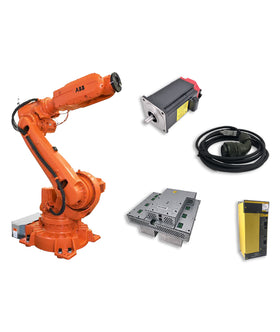
Key components commonly involved in robot axis not moving issues and replacements.


{"one"=>"Seleccione 2 o 3 artículos para comparar", "other"=>"{{ count }} de 3 artículos seleccionados"}
Seleccione el primer artículo para comparar
Seleccione el segundo artículo para comparar
Seleccione el tercer elemento para comparar
Dejar un comentario