

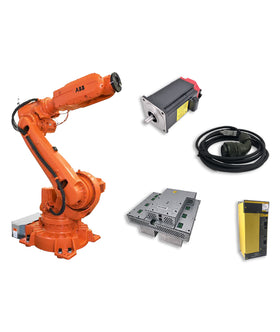
Battery packs and backup modules are the "silent guardians" of industrial robotic systems. Across major platforms ABB, FANUC, KUKA, Yaskawa, Mitsubishi, and Stäubli these components are responsible for preserving absolute encoder position data, system CMOS memory, and safety parameters during power cycles.
Failure to replace a $50 battery on schedule often results in thousands of dollars in downtime due to lost "Mastering" data and the need for recalibration.

1. Why Battery Integrity is Critical
Unlike consumer electronics, industrial robots use batteries to maintain a continuous electrical link to their motion sensors.
- Encoder Data Retention: Prevents "Position Lost" errors. If the battery dies while the robot is off, the robot "forgets" where its joints are located.
- System Parameters: Safeguards custom programs, IO configurations, and calibration offsets stored in the controller's SRAM.
- Cold Boot Recovery: Ensures the robot can be restarted instantly after a weekend shutdown or power outage without requiring a technician to remaster every axis.
2. Robot Battery Packs by Brand
Identifying the correct chemistry and part number is vital to avoid voltage mismatches.
ABB Robotics (IRC5 / OmniCore)
ABB systems often utilize high-capacity Lithium packs for both the controller and the serial measurement board (SMB).
- 3HAC044168-001 - Lithium battery pack used in IRC5 systems
- 3HAC020428-001 - Encoder backup battery for selected ABB robot axes
ABB batteries are typically located in the controller cabinet or robot base, depending on robot generation and axis design.
FANUC Robot Battery Units (R-30iA / R-30iB / R-2000)
FANUC robots are notorious for the SRVO-062 (BZAL) alarm, indicating encoder battery depletion.
- A98L-0031-0025 - Encoder backup battery pack for many FANUC robots
- A06B-6073-K001 - Battery unit associated with servo systems and memory backup
FANUC robots often generate SRVO-062 or mastering alarms when batteries approach end of life, making preventive replacement essential.
KUKA Battery Packs and Backup Modules(KRC2 / KRC4 / KRC5)
KUKA uses a combination of standard batteries and Accumulator (rechargeable) packs for controlled shutdowns.
- 00-168-334 - Battery pack used in KRC4 controller environments
- 00-105-441 - Memory or encoder backup battery for earlier KRC systems
KUKA controllers may require battery replacement during powered state to avoid data loss, following OEM service procedures.
Yaskawa / Motoman Backup Batteries
Yaskawa utilizes specialized lithium cells to back up their Sigma-series encoders.
- HW0470360-A - Encoder backup battery pack used in multiple Motoman robots
- JZRCR-BAT01 - Controller memory backup battery for DX and YRC series
Low battery alarms in Yaskawa systems can lead to absolute encoder data loss if not replaced in time.
Other Industrial Robot Brands
Additional manufacturers such as Mitsubishi, Panasonic, and Stäubli provide:
- Controller memory backup batteries
- Absolute encoder battery packs
- Combined battery modules for safety or motion systems
Exact part numbers vary by robot payload class, controller generation, and encoder architecture.
3. Types of Robot Backup Power Components
Industrial robot battery systems generally fall into three categories:
1. Encoder Backup Batteries
Maintain absolute position data for each robot axis. Failure typically requires robot remastering.
2. Controller Memory Batteries
Preserve system parameters, programs, and calibration data during power loss.
3. Integrated Battery Modules
Combine encoder and memory backup into a single serviceable unit, common in newer controllers.
4. Replacement Strategy & Best Practices
The "Power-On" Rule
For most brands (specifically FANUC and ABB SMBs), batteries must be replaced while the robot is powered up. Removing the battery while the power is off breaks the circuit, causing an immediate loss of the "Zero" position.
Signs of Imminent Failure
- Teach Pendant Alarms: "Low Battery," "Voltage Low," or "Voltage Zero."
- Date/Time Reset: If the controller clock is incorrect after a reboot.
- Chronological Age: If the battery is older than 24 months, it should be replaced regardless of alarm status.
Warning:Never use standard alkaline batteries as a substitute for high-energy Lithium (Li-SOCl2) industrial cells. Voltage drop-off curves differ significantly and can cause premature data loss.
5. How to Select the Correct Robot Battery Pack
Before ordering a replacement battery:
- Confirm robot brand and exact model
- Identify controller generation (IRC5, R-30iB, KRC4, YRC1000, etc.)
- Determine whether the battery supports encoder, memory, or both
- Verify the original part number and voltage specification
- Follow OEM-approved replacement procedure
Incorrect battery selection may result in data loss or controller faults.
6. Preventive Maintenance Best Practices
To avoid unexpected shutdowns:
- Schedule: Replace all encoder batteries every 12C24 months as part of annual PM.
- Inventory: Keep at least two spare sets per robot model in a cool, dry climate.
- Logging: Mark the installation date clearly on the battery casing with a permanent marker.
- Verification: After replacement, restart the controller to ensure all "Low Battery" flags have cleared.
Related Spare Parts & Maintenance Resources
You may also explore:
- Robot Maintenance Kits & Lubricants Index
- Robot Servo Motors & Encoders Index
- Robot Gearboxes & Reducers Index
- Robot Spare Parts Cross-Reference Hub
Together, these resources support a complete industrial robot reliability strategy.
FAQ - Robot Battery Packs & Backup Units
How often should robot batteries be replaced?
Most industrial robot batteries should be replaced every 12C36 months, depending on manufacturer recommendations and operating conditions.
What happens if an encoder battery dies?
The robot may lose absolute position data, requiring full axis remastering and calibration, which can stop production for hours.
Can I replace the battery while the robot is powered off?
Some brands allow this, but others require powered replacement to preserve memory. Always follow OEM procedures.
Are compatible batteries safe to use?
High-quality compatible batteries can be used in non-critical applications, but OEM-specified batteries are recommended for production systems.