



In the rapidly evolving field of industrial automation, delta robots — also known as parallel kinematic robots — are redefining speed, accuracy, and efficiency. These high-speed precision machines are engineered for pick-and-place operations, assembly, and inspection tasks where milliseconds matter. With their unique triangular structure and lightweight design, delta robots are becoming essential automation solutions across manufacturing, packaging, food processing, and electronics assembly lines.
A delta robot is a type of parallel robot featuring three lightweight robotic arms connected to a fixed triangular base. The arms, arranged in a parallelogram structure, maintain the orientation of the end effector, allowing only translational movement along the X, Y, and Z axes without rotation. This design makes delta robots highly suitable for high-speed pick-and-place systems where precision and repeatability are critical.
Unlike articulated or SCARA robots, the motors of a delta robot are mounted on the base, reducing moving mass. This enables rapid acceleration and smooth, precise movement, making delta robots ideal for industries that demand both speed and precision.
Key Design Features:
Parallelogram linkages in each arm keep the end effector’s orientation stable, enabling purely translational movement along X, Y, and Z axes.
Stationary motors are mounted on the base, keeping the moving arms extremely light.
Triangular base geometry distributes forces evenly and maximizes workspace utilization.
Rigid but lightweight composite arms reduce inertia, allowing rapid changes in direction without overshooting.
From an engineering perspective, a delta robot can be seen as a three-dimensional four-bar mechanism—a concept that gives it both mechanical simplicity and dynamic capability.
The delta robotic system operates with a fixed base positioned above the workspace. From this base, three lightweight arms extend downward, connecting to a small triangular platform — the end effector — via ball-and-socket joints. Each arm is powered by its own motor, and their coordinated movement positions the end effector with exceptional accuracy.
Key features of this mechanism include:
Fixed Base Design – Keeps heavy actuators stationary, minimizing inertia and boosting speed.
Lightweight Robotic Arms – Made from composite materials to ensure faster motion with reduced energy consumption.
Parallelogram Linkage – Maintains constant orientation for precision handling.
High-Speed Capability – Enables movement rates of hundreds of picks per minute in industrial automation environments.
This architecture allows delta robots to outperform other robots in high-throughput tasks without overheating or motor strain.
Delta robots are champions of rapid product handling, capable of performing up to 300 picks per minute in some models. They are widely used for:
Sorting chocolates, candies, and baked goods.
Moving electronic components from conveyors to assembly lines.
Loading blister packs in pharmaceutical production.
In electronics and medical manufacturing, even the slightest misalignment can cause product failure. Delta robots excel at:
Mounting delicate circuit boards.
Assembling micro-mechanical devices.
Fitting tiny components into complex assemblies.
With high repeatability and controlled motion, delta robots are ideal for:
Applying adhesives in automotive components.
Dispensing sealants on glass panels.
Coating microchips with protective films.
Delta robots can stack cartons, pouches, or bottles onto pallets at high speed, often directly from the production line. Their compact footprint allows integration even in space-constrained facilities.
When equipped with machine vision systems, delta robots can:
Identify product defects in milliseconds.
Verify labeling accuracy.
Ensure packaging consistency in real time.
Compared to Articulated Robots:
Speed Advantage: Delta robots move lighter components, enabling much faster cycles.
Maintenance Savings: Fewer moving joints reduce wear and tear.
Compared to SCARA Robots:
Workspace Efficiency: Delta robots cover a larger 3D workspace without increasing footprint.
Precision in Motion: Better suited for high-speed continuous pick-and-place over moving conveyors.
Compared to Cartesian Robots:
Compact Design: No long linear rails required, saving floor space.
Dynamic Capability: Handles acceleration and directional changes better.
Cycle Rate: 100–300 cycles per minute depending on payload.
Payload Capacity: From a few grams to over 60 kg (model-dependent).
Accuracy: ±0.1 mm or better after calibration.
Energy Efficiency: Low moving mass means lower power consumption per operation.
Longevity: Minimal mechanical wear extends operational life.
With the global push for Industry 4.0 and smart factories, delta robots are being integrated with:
AI-powered vision systems for autonomous product handling.
IoT connectivity for predictive maintenance.
Collaborative safety features enabling human-robot co-working.
As production lines get faster and more customized, delta robots will continue to dominate in industries where speed, precision, and adaptability are critical.
Whether you need a compact high-speed picker for a food line or a heavy-duty delta for palletizing, inrobots.shop offers:
Detailed technical specs for multiple models.
Side-by-side performance comparisons.
Direct purchasing and worldwide delivery.
Q: What industries benefit most from delta robots?
A: Food processing, pharmaceuticals, electronics, packaging, and warehouse logistics.
Q: Can delta robots be customized?
A: Yes. End effectors, payload capacity, and vision integration can be tailored to specific needs.
Q: How long can a delta robot operate without major maintenance?
A: With proper care, many operate for years with minimal servicing thanks to their low mechanical complexity.
Explore the Full Guide: Industrial Robot Knowledge Hub → Industrial Robot Types & Applications Cluster
Explore the full guide to compare options and select the right components for your industrial automation needs.
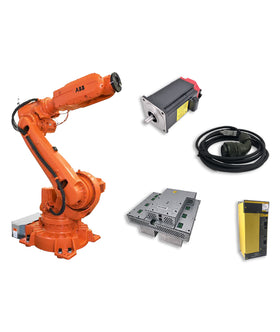
Key components commonly involved in robot applications issues and replacements.


{"one"=>"Wählen Sie 2 oder 3 Artikel zum Vergleichen aus", "other"=>"{{ count }} von 3 Elementen ausgewählt"}
Wählen Sie das erste zu vergleichende Element aus
Wählen Sie das zweite zu vergleichende Element aus
Wählen Sie das dritte Element zum Vergleichen aus
Einen Kommentar hinterlassen